
Who's behind the news?
Who's behind the news?
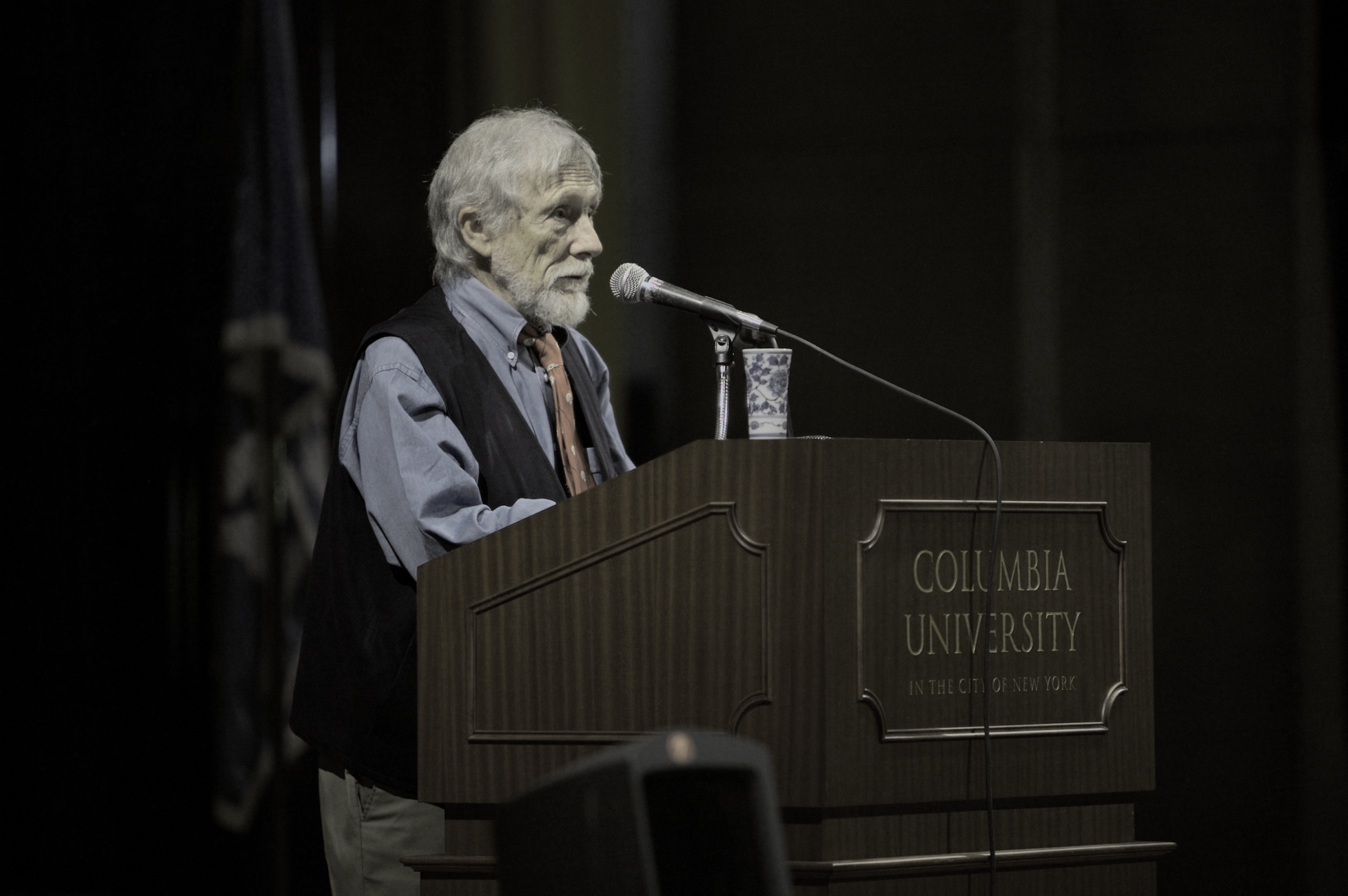
In Why I Take Good Care of My Macintosh, the Beat poet brings his lifelong fascination with tools, nature and impermanence into the computer age
Why I Take Good Care of My Macintosh
Because it broods under its hood like a perched falcon,
Because it jumps like a skittish horse
and sometimes throws me
Because it is poky when cold
Because plastic is a sad, strong material
that is charming to rodents
Because it is flighty
Because my mind flies into it through my fingers
Because it leaps forward and backward,
is an endless sniffer and searcher,
Because its keys click like hail on a boulder
And it winks when it goes out,And puts word-heaps in hoards for me,
dozens of pockets of
gold under boulders in stream beds, identical seedpods
strong on a vine, or it stores bins of bolts;
And I lose them and find them,Because whole worlds of writing can be boldly laid out and then highlighted and vanish in a flash at "delete" —so it teaches of impermanence and pain; And because my computer and me are both brief in this world, both foolish, and we have earthly fates, Because I have let it move in with me right inside the tent And it goes with me out every morning We fill up our baskets,—get back home, Feel rich, —relax,—I throw it a scrap and it hums.
— Gary Snyder (1930–present)*
Gary Snyder was born in 1930 in the Pacific Northwest, worked on a dairy farm in northern Washington state, and grew up in San Francisco. He studied Asian languages at U.C. Berkeley, developed a strong interest in Japanese Zen Buddhism, particularly zazen, and later spent several years in Japan studying the language and practicing Zen.
He first made a name for himself when he participated in what is now the legendary Six Gallery poetry reading in San Francisco in 1955. Other participants included Allen Ginsberg, who famously read “Howl.” Snyder was told, “Save the invitation. Someday it will be worth something.”
Snyder became friends with Ginsberg and was associated with the Beat generation of novelists, poets and other artists, a movement that emerged in the late 1940s and flourished through the 1950s. Its writers experimented with a variety of poetic forms—and sometimes with no readily recognizable form at all.
His first collection of poetry, Riprap, published in 1959, drew on his experiences working in Yosemite National Park. Snyder was an outdoorsman throughout his life, taking jobs that brought him close to nature and made use of his skills as a carpenter and laborer. He worked in the Sierra Nevada and the forests of Oregon, served as a fire lookout and went to sea. He once said he was “at home everywhere.”
That background makes “Why I Take Good Care of My Macintosh,” particularly interesting. At first, a poem about a personal computer might seem an odd choice for a writer so closely associated with mountains, forests, Zen and manual labor. But Snyder treats the Macintosh much as he treats the physical tools and natural objects that appear throughout his poetry: by looking closely at what it does, how it behaves and what kind of relationship develops between the object and the person using it.
Written in 1988, the poem is structured largely as a series of reasons—one “because” following another—for Snyder’s affection for his machine. The computer becomes alternately animal, tool, companion and storage place. Snyder describes it through imagery drawn not from the office but from the natural and working world he knew so well: horses, falcons, stones, seeds, bolts and hidden treasure. The effect is both playful and revealing. Technology has entered Snyder’s world, but he interprets it through the vocabulary of that older, tangible world.
The poem is funny, too. Snyder does not romanticize the machine. It can be temperamental and frustrating, and its apparent intelligence remains inseparable from its foolishness, and ours. Yet there is genuine affection in the relationship. The Macintosh is another tool with which he works, and therefore something worthy of attention and care.
More importantly, the poem eventually moves beyond affection for a piece of technology. The ability of a computer to preserve words and then make them disappear instantly becomes a lesson in impermanence, one of the central ideas of Buddhism. Snyder recognizes that both the machine and its owner are temporary occupants of the world. What begins almost as a comic catalog of computer quirks becomes a meditation on mortality.
That shift is characteristic of Snyder. The ordinary object is never merely an object. A trail, an axe, a mountain, an animal, or even a Macintosh can become a way of considering our place in the world.
Snyder emphasized poetry’s uniqueness and irreplaceability: “There are things that you cannot say except in poetry, and these are the things I had to say.” “Why I Take Good Care of My Macintosh” demonstrates the point nicely. An essay could describe the relationship between a writer and his computer, but Snyder’s accumulation of images lets us experience the relationship instead.
He was also drawn to haiku and Asian poetic traditions, interests strengthened by his study of Japanese language, culture and Zen. He later described haiku as “part of the poetics of mid-century America.” Like haiku, much of Snyder’s poetry depends upon close observation: look hard enough at an ordinary thing and another meaning begins to emerge.
Nature, work, Buddhism and the relationship between human beings and their surroundings remained recurring subjects throughout Snyder’s career. “Why I Take Good Care of My Macintosh” expands that landscape. The modern technological world, it suggests, is not necessarily separate from the natural one. A computer can become another creature in the household, another tool in the workshop and, unexpectedly, another reminder that nothing lasts.
Snyder received the Pulitzer Prize for Poetry in 1975 for Turtle Island and the Bollingen Prize in American Poetry in 1997. His work has since become a fixture of contemporary American poetry anthologies, while his essays and commentary have helped establish him as an important voice on literature, ecology and humanity’s relationship with the natural world.
* Why I Take Good Care of My Macintosh is used with permission from the collection This Present Moment (Counterpoint), published in 2015.
Column © 2026 Newsjunkie.net