
Who's behind the news?
Who's behind the news?
The Prison Policy Initiative is a non-profit research organization that produces analyses of the US carceral system.
The Jail Data Initiative (JDI) is a project from New York University’s Public Safety Lab that scrapes daily county jail rosters.
The Vera Institute of Justice is a non-profit research and advocacy organization focused on the US criminal justice system and prison reform.
Data behind bars: Incarceration, missing federal statistics, and why erasure is dangerous
Wanda Bertram is a communications strategist at the Prison Policy Initiative, a nonprofit research and advocacy organization that produces widely cited research on mass incarceration and the broader criminal legal system. Her work translates complex government data into accessible analysis for journalists, lawmakers, and advocates. In this conversation with Newsjunkie.net staff reporter Morgan Kriesel, she discusses what data we need to meaningfully check the carceral system—and what happens when that data disappears.
“When it comes to local jails, we are using data that is literally from the early years of the 21st century, like it's over 20 years old.”
To get started, tell me about what data we need in order to provide checks on the carceral system.
I think the data that has gotten many people's attention about the carceral system is some of the really basic data, like the sheer numbers of people in the system, and the rate of incarceration that we have in this country compared to some of our peers. The fact that the US, for a long time, was the undisputed world leader in incarceration, and now we are behind only El Salvador in incarceration rates—a country that's run as a police state by one of Trump's friends.
The data on racial disparities in prisons and jails is also some of the basic data that has gotten people really up in arms about who is in prison—what the criminal justice system actually exists to do. And you know, in part, because the racial disparities also signify that there's class issues in the criminal legal system.
These aren't data that necessarily require that much independent work to get. The census can give us a lot of the information that we need, but the problem is that, without a dedicated government office collecting and disseminating this data, we won't get it very often. That's why we have a division of the Department of Justice called the Bureau of Justice Statistics, whose job it is to collect this data on a regular basis and put it out into the world.
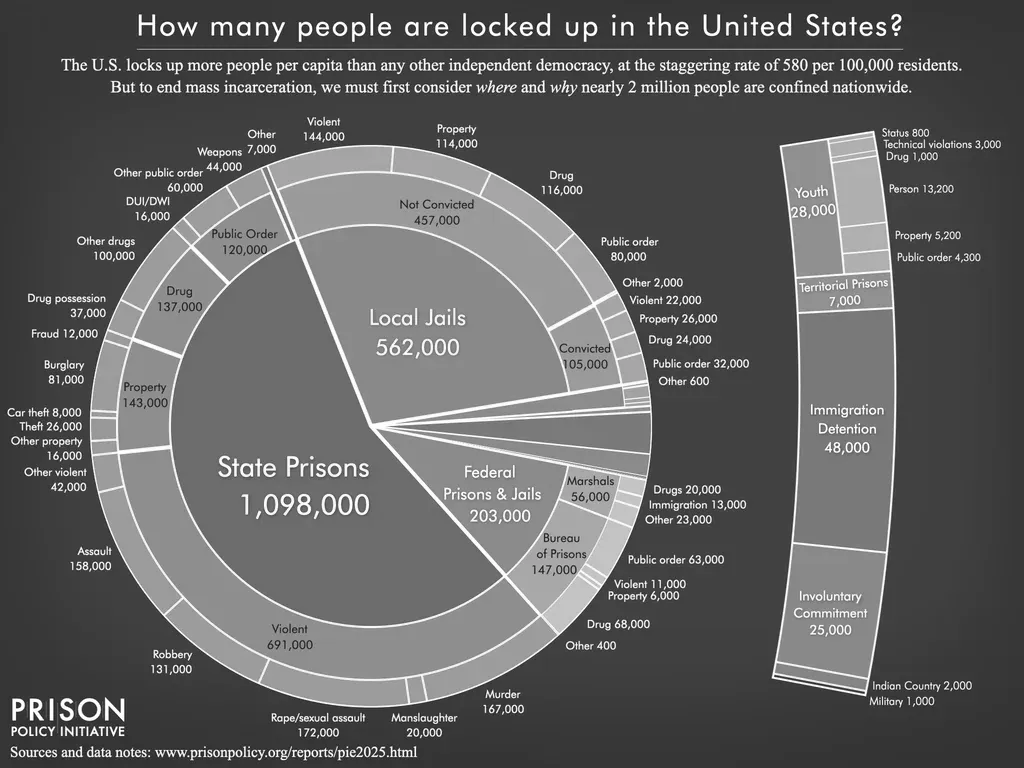
The reports that they do that we really couldn't live without would be their Prisoner Series, which is roughly annual. Although it's pretty behind. The last data, which is from 2024, came out last December. They have a Jail Inmates Report series. This is also behind. They have a similar series of reports about Populations of People on Probation and Parole. This is even more behind, the last report we got was with data from 2023 that came out in July of last year [2025]. Those give us the sort of big picture numbers for a report like Mass Incarceration: The Whole Pie, which we strive to do every year. To give the full, bird's-eye-view of the criminal legal system, we need those basic population numbers.
But to go deeper into who is actually behind bars, you need other kinds of data collection that BJS does, most notably the Survey of Prison Inmates and the Survey of Inmates in Local Jails. Now, the Survey of Prison Inmates, we haven't gotten one of those reports in 10 years. The last one was collected in 2016. I believe it came out about five years ago. The Survey of Inmates in Local Jails—I'll probably spend a lot of time talking about this call, because it's woefully behind. This report came out last in I think 2002.
They're large scale surveys of incarcerated people asking about things like their conviction, what they are being held for, their demographic—some of their demographics that may not be accounted for in the census or maybe things that, in an ideal world, you would want people to self report, as opposed to have the government decide. Jails and prisons often can't be trusted to make a determination about someone's race. There's questions about their experiences while they're incarcerated, their experiences with disciplinary systems, with solitary confinement, how long they've been serving time, the experiences that they've had in their lives prior to being incarcerated.
The Survey of Prison Inmates, for example, is the report that has given us insight into how many people who are in prison today were in the juvenile justice system before they were in adult prisons, how old they were when they were first arrested, and so how long they have been circulating through the system. That's an important insight. But even something as simple as what are people in prisons and jails doing time for?
We put together a Whole Pie report every year, which is broken down, first, into what types of facilities people are incarcerated in, and then, second, into what they're serving time for. When it comes to local jails, we are using data that is literally from the early years of the 21st century, like it's over 20 years old. And while we don't necessarily think that things have shifted radically, it's still worrisome to not have current data. To be able to say, ‘in the last few years, X number of people have been held on drug offenses’ that's an example of something that I think the public would care about.
So we're not able to say that for certain populations at the moment?
Correct. Particularly with jails, we just have to speculate.
I imagine these populations are changing daily, right? So the years in between publications of the data would make that an issue?
Yeah, absolutely.
I think there are also important cross demographic insights that we're missing. For example, since the late 1990s, we know that there has been a change in the age demographics of people in the system. The number of people 55 or older is five-times greater than it used to be. Fifteen percent of the prison system now is people over 55, it used to be 3%. And there's been a similar jump in arrests. So it'd be really nice to know, for instance, with this kind of epidemic of older people being arrested and thrown into local jails—what is that for?
Because we can speculate again about what that is, and how perhaps this could be driven by the opioid crisis, or by gaps in the social safety net. Things that inform, not just how we talk about the criminal justice system, but also how we talk about things like, “What does it mean to kick a ton of people off of Medicaid? Or to raise the age limits for Medicare? Or create work requirements for people so that they can't access SNAP benefits anymore, if you're between the ages of 55 and 65, unless you can prove that you're working? What does that do downstream?” Without that data, we can't tell that as easily.
What are the consequences of not being able to identify these patterns?
When research is being informed by people who are involved in the system, or who have been involved in the system, you have a sense of the injustices that are taking place. And it becomes a matter of trying to put data to someone's lived experience. That's something that without the proper data, you can't do.
For example, someone says, “When I was in prison I had a serious health issue. And I tried to tell the corrections officer about it, and I never got to see a doctor.” Or, “They told me I was going to be able to go to an outside hospital, and it never happened. I'm pretty sure that my medical request just got shoved in a drawer somewhere.”
It would be nice to be able to count the number of times that actually takes place.
Without data on how often certain experiences happen, it's hard to get policymakers and lawmakers to care about fixing these problems.
“One in every three people behind bars in this country is in a local jail, the vast majority of whom have not been convicted.“
Data is a big myth-buster, right? It's easy to make assumptions about prisoners. We like to think, “That could never happen to me. Or those people are there because they deserve to be.” It's easy to ignore prisoners’ complaints because you can think of them as liars. Being able to back up their stories is one reason why data collection is important.
Yeah. And there are a lot of well-meaning people who understand that mass incarceration is an issue. But they think that’s because a few private prison companies have made big payments to lawmakers to ensure that they build prisons, they somehow rigged the system to bring more people in. They think it's a gigantic conspiracy that is out of our hands, and has nothing to do with voting decisions or policy decisions that we can influence. That's just nonsensical.
Most people think of incarceration as being about prisons. People will often say “jail” when they mean “prison,” not realizing that what jail actually refers to is this facility that's in their community, run by a sheriff who they elected, and it's mostly full of people who are awaiting trial. One in every three people behind bars in this country is in a local jail, the vast majority of whom have not been convicted. That can help us see that mass incarceration is actually a product of local policy. Things like whether we choose to require someone to pay bail before they can go free before their trial. That's part of why we have this unprecedented, unparalleled global incarceration rate.
I think one of the issues with people interpreting mass incarceration as having just like a single cause or being a conspiracy, is that it really discounts the stories that people tell, true stories from their lived experience about how they ended up in these systems. Without paying attention to that, we don't understand things like the consequences of stop and frisk, or the consequences of deploying police to handle homelessness, or things like that. Data can certainly help us create a concrete narrative around that.
“The massive cuts to Medicaid that have been implemented under the second Trump administration are going to lead to an influx of people into the criminal justice system.”
I've been thinking a lot about the recent policy decisions that we will have a harder time measuring because of this lack of data. Can you think of anything that would specifically impact the criminal legal system that we will have a hard time being able to track?
The massive cuts to Medicaid that have been implemented under the second Trump administration are going to lead to an influx of people into the criminal justice system. That's something that we will need to wait on the data to understand.
Of people who are in state prisons, the Survey of Prison Inmates asked them, “Did you have health insurance before your incarceration, in the lead up to your incarceration, and if so, where did that come from?” Fifty percent of people in state prisons said “I had no health insurance.” And of those that said they did have health insurance, a larger percentage than in the general population said they had Medicaid—it was about a third.
So we can already tell that people who go to prison are marginalized and in poverty or low income. We can also make a judgment about the importance of health insurance to keep people out of jail.
Unfortunately, this is a data collection that, again, we haven't gotten more recent data than this in like 10 years.
But to get more data about the experiences of people before their incarceration, before they went to prison or even before they entered their local jail, will help us kind of see the impacts of cutting social services, as the federal government continues to do.
I've also been seeing changes to mental health and substance abuse data, like the Drug Abuse Warning Network from Substance Abuse and Mental Health Services Administration (SAMHSA). Do you think that is a factor as well?
We used some survey data from SAMHSA to figure out how many people who were on probation had health insurance and were getting drug treatment and mental health treatment, because [SAMHSA], in their surveys, asked questions about people's correctional status and whether they are on supervision [to monitor behavior, ensure compliance with court-ordered conditions, and assist with reintegration into society].
We had not ever been able to get this from BJS [Bureau of Justice Statistics] data before, but with SAMHSA data, we did. We found out how many people who were on probation were not insured, how many people were seeking treatment for drug issues or mental health issues, but were not receiving it. It was a pretty big number. People who were not getting treatment, even though they had expressed needing it, was somewhere between like a quarter and a third of people.
These systems tell us that they exist as an alternative to incarceration, as this way of getting people who present a low risk to the community connected with services so that they can get their lives back on track. This may not actually be what's going on, and these could be systems that are actually mostly serving to punish people and pull them out of their communities and incarcerate them at the earliest opportunity, while not actually getting them things like healthcare.
“If you don't collect this data, their stories are completely obscured.”
Are there any other sets that are critical that are missing?
I'm going to start to sound like a broken record here, because the one that we're really grieving about is the Survey of Inmates in Local Jails. There are so many jails in this country, so unless the federal government dedicates itself to collecting data and disseminating data, to [providing] the national picture of what jails look like, we just won't know what's going on there.
There's also the Mortality and Correctional Institutions series, which BJS stopped publishing a couple years ago. There was a change in how this data was supposed to be reported to the federal government, which led to the data reporting becoming worse. Then BJS was like, “We're just not going to publish this anymore.” And as a result, we haven't had national data for several years showing how many people die in prisons and jails. That’s huge.
Reporters will call me and they'll say, “Hey, I got a FOIA request back showing that X number of people died in my local jail last year. Is that out of the ordinary?” And the most recent data that I can give them to point to is from 2019.
Then, of course, the sexual orientation and gender identity data. Under the second Trump administration, BJS surveys are not going to include questions about people's gender identity, which is particularly hard to take because it took so long for the government to decide that it would start collecting this. We have just a couple years of data collection that might suggest how many people in prisons and jails are queer, how many people are trans. If you don't collect this data, their stories are completely obscured. You get women who are held in men's prisons, men who are held in women's prisons, and that all just becomes invisible.
When you're invisible, you are an easier target, right? There's nobody who can speak out for you.
I mean, federal prisons just announced that they're going to stop providing any kind of gender affirming care. How many people are going to be put in life threatening situations because of that? We don't know.
A possible consequence of this data being erased is it makes it easier to terrorize certain groups. There can be a domino effect that leads to expanding who is targeted.
Yes. One in every three women in prison identifies as gay or bisexual.
When I saw that, as someone who is straight and cis, it completely changed my understanding of who is in the criminal legal system. And also, not just how the criminal legal system works, but how our society works.
What happens to people who are queer? What happens to people who are queer and they run away from home and they don't have a strong support network? What does it look like?
I would say queer people, and queer young people in particular, are some of the most vulnerable and isolated people in our society. Through data like this, we're able to see what happens to people who are marginalized and how many of them end up in prisons and jails.
I can't really speculate about what is going to happen, and how the experience of incarceration might change for gender non-conforming or queer people, now that we no longer have this kind of data collection. But I can say that, without knowing how many people who are gender non-conforming are in the system, we're just not going to be able to process collectively what happens to marginalized folks.
I think a lot of people who are interested in incarceration can remember how it felt the first time they learned that one in three black men has a felony record. Or the fact that you've got huge, huge numbers of people, mostly black people, locked up for drug offenses from the war on drugs. Those are revolutionary numbers because they help people reorient their whole view of the system, who it protects and who it hurts. Taking that kind of data collection away is just a setback for everyone.
“…jails are really the ICE cash cow. “
Your work is separate from the data coming out of immigration detention centers. But do you see a connection between the opaqueness there and where we're heading with less data from federal prisons?
I would say that the detention centers are honestly a little bit like jails. Many of them right now are overcrowded. There's a lot of people coming in and then moving out very quickly, such that people cannot track where their loved ones or friends are. There is a similar churn through local jails. I'd say there is probably a kind of an analogy to be drawn there.
The immigration—we call it the “crimmigration” system, the criminalization of immigration enforcement—does create a lot of overlap with prisons and jails. We did an analysis recently where we showed that a huge number of people who have been arrested by ICE in the last year have been arrested directly out of local jails. That's because when you're arrested and you're booked into jail, you're fingerprinted and your basic bio data goes directly to the FBI. Then Homeland Security can access it, and ICE can follow up with the local jail and ask them to hold you for an additional 48 hours. If the jail complies, ICE can just pick you up directly from jail.
Even though most of the media focus (understandably so) has been on immigration raids happening in neighborhoods, workplaces, and courthouses, jails are really the ICE cash cow. If you're undocumented in this country, you can be arrested for something like driving without a license. You're brought into jail. You may not have even been convicted, but you can still be picked up by ICE out of that jail. Jails are a huge feeder to ICE in that way.
When we have this kind of erosion of our privacy and our local jail data is sent straight to the feds—on one hand, you can have not enough data, and on another hand, you can maybe have too much.
I guess it depends on what it's being used for.
What is exciting about the independent data movement is that people have become interested in data governance. Where do we store it? How do we maintain public access? But data privacy, who gets the data, and what is it being used for are also huge issues. What’s your reaction to that?
I think there are some concerns about people in prison reporting data accurately, because they know that they're being surveilled. That makes me think of people who don't necessarily want to disclose something about themselves because it might get them in trouble. The extent to which data is used by the justice system to build a case against you, constrains the quality of data. I don't think that's a reason not to collect it, but that is one side of this.
“[There] are things that we won’t get good federal data on—we've never had it, and I don't think we ever will…we have to rely on independent researchers.”
You work with a “constellation of organizations.” Can you tell me a little bit about what that looks like?
There are organizations that are devoted to providing and creating data, and research, around the criminal legal system—we're one of those. Then there are organizations that are primarily advocacy organizations that do data collection and research in furtherance of their policy goals. And then there are academics who are doing really diligent and rigorous work, often about specific facilities or specific prison systems or jail systems. Journalists, I would say, are also big contributors to public knowledge around the criminal legal system. There's a big world out there of people who are collecting this data.
The Vera Institute of Justice—which has, or at least has had in the past, a very large data collection arm—basically replaced a lack of data from BJS about the number of people in prisons and jails in some years, just because they got impatient with how slowly it was coming.
The Jail Data Initiative has pioneered some solutions to the lack of data about local jails by doing web scraping of jail websites and jail rosters. Because a lot of jails make their inmate rosters public, the Jail Data Initiative now has a dataset that comprises data from many jails across the country, which is really useful.
There's organizations that are working via the public record request process. The UCLA Behind Bars Data Project, which is collecting a lot of data about deaths in prisons using the Freedom of Information Act (FOIA). Out of Johns Hopkins, there's a project called the Pregnancy in Prison Statistics (PIPS) project. They're led by Carolyn Sufrin, and they've been collecting data from like 23 prison systems about pregnancy prevalence and pregnancy outcomes in jails and prisons. I would say that they have eclipsed anything that BJS has done on that topic.
Interestingly enough, BJS did its first report about pregnancy in prisons last year, and they determined that about 2% of women coming into prisons every year are pregnant. But PIPS had previously found that it was higher. It was like 4 or 5%.
It's a good thing to have academics and researchers independently doing this, because these are areas where I just think that the system is not keen on having the public know. [For instance,] how many pregnant women are locked up, and how many babies are born in custody every year (it's about 700).
The areas where I've seen the most tenacious research are in deaths behind bars, healthcare, prison food, the financial burdens of justice involvement, the burdens of being on community supervision. These are things that we won’t get good federal data on—we've never had it, and I don't think we ever will. The criminal justice system has no interest in people knowing how bad prison healthcare is. When it comes to an issue like that, we have to rely on independent researchers.
Do you do much collaborative work with these other organizations?
When we see data that's been collected and we think that more can be done with it or we think that it should be more widely known because it's really useful, then we do what we can to make that happen.
We've done several publications with the Jail Data Initiative’s (JDI) big data collection around who is in local jails. We did one that was about homelessness, using data that they had scraped from hundreds of online jail rosters. I think that filled a huge gap. There's nothing national to show like, “Here's how unhoused people are being forced to churn through the criminal legal system over and over again.”
More recently, my colleagues did an analysis with JDI data on how many people go to jail for failing to appear at court. They estimated that about one in every eight jail bookings is related to failure to appear.
So [PPI is] using the data that's out there to try to generate policy related insights that might move or inspire a lawmaker to do something like change their local laws around what is jailable.
We are preparing to write up some data that was released and some research that was done, not by us, about grievances in the federal prison system. The grievance process is important because it incarcerates people's first and foremost avenues for getting civil rights issues resolved, but unfortunately, a lot of grievances end up going nowhere. Nobody ever takes a look at them. My colleagues saw this research and thought, “This is worth uplifting,” because there are a lot of other people, advocates for incarcerated people across the country, who may find it necessary to show to a court so they will take this person's legal complaint seriously. It's likely that they have already tried to get this issue resolved through the established channels in prisons, and it's been ignored.
We uplift research that says something important about the system. Even if it's just drawing conclusions about one specific prison system, we want people in other areas, other parts of the country, to see it. This is where we function a little bit like a magazine—publishing, just doing a blog post, pushing it out to everybody who subscribes to our work, putting it on social media, all the mass communication channels available to us.
In other areas of independent data, there's a movement to become a bit more organized, especially ex-federal scientists—people who have been fired or forced to scale back the quality of their work. I just attended a webinar for a bunch of public data advocates, and they were all stressing coalition building.
I think that there has been a similar attrition of people able to do government funded-research into the experiences of people in the justice system. People like that have had funding yanked out from under them. Just as people in the labor world, or the climate world, or medicine have been struggling.
I haven't seen any kind of attempt at forming ranks around that. The criminal legal system is an area that has been suffering from a lack of data for so long that I think we're already—this is a little bit depressing—it's already ossified into organizations that are independent from each other. They're often driven by discrete missions.
The civil society data collection field around prison and jail issues is more longstanding, and more kind of set in its ways, than for people in other fields who are maybe just now finding themselves out in the cold because of a lack of government funding. I don't think there's really that same impetus in this world to all of a sudden grab onto each other and close ranks.
“If you’re inspired by this moment to get involved in doing research around the criminal legal system, there's no time like the present.”
In one of your recent newsletters, you said, “The criminal legal system was built on a foundation of structural and systemic racism,” which I think you could say about a lot of the systems in this country. The willingness to recognize that is something that I've found to be unique to your field. Do you have any comments on that?
I think that the field of prison studies emerges from a lack of information from the government. I think there's that sort of disruptive, or perhaps antigovernmental, narrative streak that runs through a lot of different organizations doing this work.
For instance, Bureau of Justice Statistics reports will come out about prison populations, and they will contain narratives that we, and many of our peers in this space, will actively push back on. I remember one BJS report that found and then seemingly did its best to obscure the fact that people convicted of violent offenses and sex offenses had the lowest recidivism rates out of any group. That's not a fact that they want to put out there. It doesn't fit the standard prosecution-side story that these individuals are the worst of the worst: “Not only do we want to punish them the most, they also pose the greatest danger to society.” That's been found over and over again not to be true.
The people who are working in prison studies have learned not to trust the narratives that are coming out of the government. There’s an extreme willingness to push back openly and say, “This is BS.”
As people who have had practice with acting more as watchdogs and calling out misinterpretations of the facts, do you have advice or best practices for these new groups that are forming that are having to maybe look at the flaws in the systems that they worked within for the first time?
People who have been working within government-run or government-driven research for a long time have whispered critiques. They’ve been saying, “This is conventional wisdom, but we don't believe it,” or, “We should be collecting data about this, and we never have.” Now's the time to explore that. If you pursue the things that, as an academic or as a researcher, you intuit are important, you can't lose.
I feel like government support for research is a blessing and a curse. You may as well take the good with the bad when it comes to being cut loose by the government.
Do you see avenues for local organizations, community efforts, maybe independent researchers, or independent journalists, to help out with the lack of data?
If you’re inspired by this moment to get involved in doing research around the criminal legal system, there's no time like the present. To go back to something that I've been hammering on—jails that are run in by sheriffs that you elect are the front door to mass incarceration. Nobody who's in prison does not first end up in a local jail. And jails contain some of the truths about how people are funneled through the system.
For example, criminal justice fines and fees. If you're on parole and you can't pay a fee, you get thrown in jail. There are other technical rules that people can be overwhelmed with and, by failing to comply, end up in jail. People are increasingly ending up in jail for issues related to substance use, and behavioral health and mental health. All of these things, I think, are where there's an opportunity for new research to be done.
The good news is that most local jail policy is made by local officials. If you're a researcher, and you're interested in the criminal legal system, look at your local jail—who is in there, and why they're there, and perhaps what ways the system or the social safety net might have failed them before they ended up there?—is just as important as it's ever been. And in the aggregate, those kinds of local studies can really help show and inform more national research about these issues.
You said that a lot of these jails have their rosters on a public website. Do you have other tips for researchers or journalists trying to start investigating their local jails?
The Jail Data Initiative has a lot of data available on their website, but they also have more data that, for various reasons, they haven't been able to share publicly. I’ve worked with them a number of times and they're great partners. They often work with independent researchers.
Anything else that we need to know about independent research, or about the Prison Policy Initiative’s work?
We have something called our Research Library. Everything that I've talked about is just the tip of an iceberg of research. Readers that are interested in a particular topic within the criminal legal system world should check it out. I think that's a great place to start.
We encourage people that have research to submit it to us. We're interested in everything from people's doctoral theses, to community groups who have done surveys of people in their local jails or their state prisons, to larger data collections from the government or from other organizations that we consider our peers.
Edited for sequencing and clarity.
Newsjunkie. Wanda Bertram, interviewed by Morgan Kriesel, February 20, 2026
© Newsjunkie.net 2026