
Who's behind the news?
Who's behind the news?
Independent research and records preservation institute
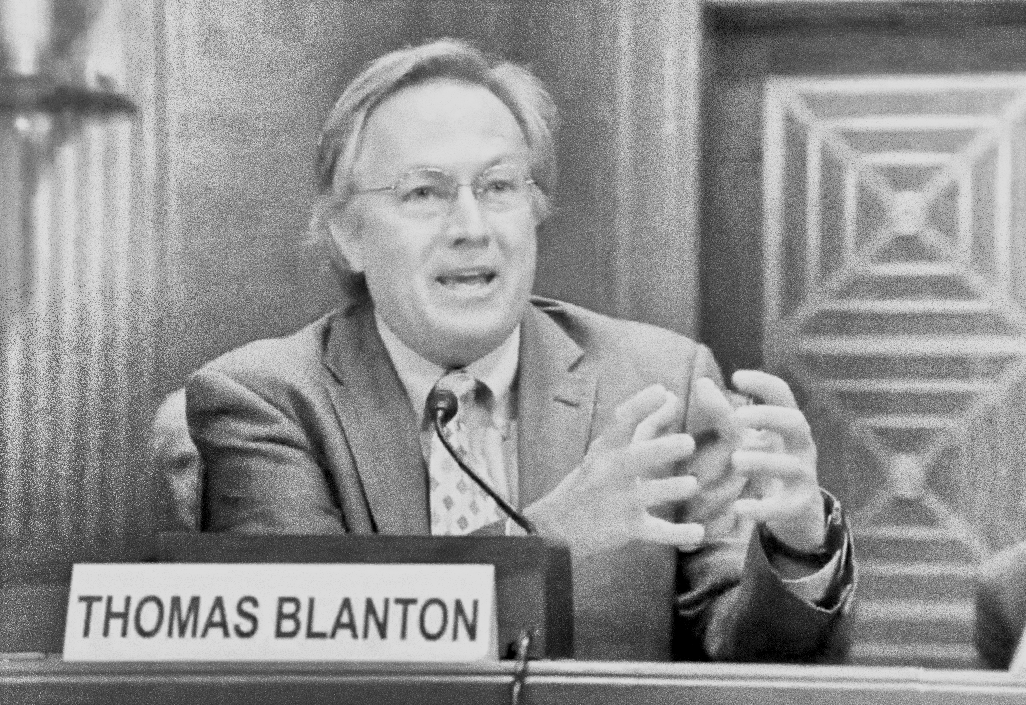
Thomas S. Blanton is an American journalist, editor, and archival researcher, currently serving as the director of the National Security Archive at George Washington University. The National Security Archive is an independent research institute devoted to obtaining, preserving, and publishing declassified U.S. records. In that role, Blanton has helped make secret documentation on U.S. foreign and national security policy available to scholars, journalists, and the public. |
Please introduce yourself and your organization.
My name is Tom Blanton. I'm the director of the National Security Archive.
Let's start with your approach to getting your arms around what's been damaged or impacted or cut. How do you approach this rather titanic matter?
We got started because a bunch of historians and journalists had used the Freedom of Information Act (FOIA) and gotten documents out of the government. We probably hit the big time with Iran-Contra, because we had documents on the Contras and on the Iranians who had taken the hostages. So when the scandal broke, we were the folks who actually had the evidence — actual classified documents from the CIA and from the contras themselves. That kind of put us on the map.
The segue that really brings us to today is when we found out, partly because of those investigations, that the Reagan-Bush White House was going to destroy all the backup tapes of their email. By that point we knew email was one of the ways Ollie North and John Poindexter managed that covert operation. So we went to court on the last day of Reagan's presidency — January 19th, 1989 — and got a temporary restraining order to save the White House email backup tapes. The government's position, even the National Archives' position, was that these were just telephone message slips.
Early days of email, and you were already aware of its significance.
We were aware of it because as the Iran-Contra scandal broke, investigators from the Tower Commission talked to the White House IT people, and the IT people said, "Oh yeah, we routinely have backup tapes in case the system crashes. But we saw the president fire the national security advisor and the scandal on the front pages, so we set aside the backup tapes for that month. They're down here on the shelf." A career military officer had just taken that initiative to save the tapes. Outsiders had no idea.
Since that time we pursued the litigation, and we actually ended up having to sue every president all the way through Obama to get digital archiving in place systematically — not just at the White House but at the higher policy-making levels.
Is this beyond FOIA, or is it primarily FOIA?
This is beyond FOIA because it involves all the federal records laws and the Presidential Records Act, which Trump is trying to avoid and declare unconstitutional in effect. The point is simply that no president likes outsiders knowing what they're doing and how they're making decisions. There's an institutional, bureaucratic knee-jerk: we want total presidential control. But we won the precedent that it doesn't matter the format — email, WhatsApp message, even a substantive voicemail. If it involves government decision-making, policy and practice, the rights of citizens, or evidence in an ongoing criminal inquiry, it's got to be saved under the records laws.
We've had strong allies inside the government — professional archivists, people like that army colonel who saved the White House backup tapes — who really carry out the law. Without them we'd be sunk, because it's impossible from the outside to police every rogue government official like Oliver North.
How were you challenged during Trump's first term?
We brought several lawsuits together with groups like the diplomatic historians, the American Historical Association, and Citizens for Responsibility and Ethics in Washington. We lost and we won. We lost in the sense that the courts were already drawing the line we see in today's Supreme Court — that the president has enormous unilateral authority. But the last lawsuit we brought against Trump won. We got a commitment that the government would archive all of Jared Kushner's WhatsApp messages and everyone else who had been using WhatsApp. They were using it to get around accountability — it was off the books, no automatic archiving. By bringing that lawsuit, we compelled the White House staff and the National Archives to go in and save all those messages that otherwise would have just disappeared.
Are you up to the task of what's being asked of you now? The scale seems overwhelming.
We're tiny and nonprofit. Our annual budget is just under $3 million. We get close to $1 million some years from universities and public libraries that subscribe to our digital document publications through ProQuest. We also depend on private foundations — Carnegie, MacArthur, Hewlett, Spitzer — who give us grants because the researchers they support, whether on human rights, international affairs, national security, or nuclear policy, come to us for primary sources. We are the evidence people. We have declassified more documents than anybody else, and that's the hardest place for FOIA to work. It takes years and a lot of persistence.
The scale of the task is so much bigger in Trump's second term than it was in the first, because from day one they really set about destroying as much of the international apparatus of government as they could. USAID, a big chunk of the State Department, all the probationary employees at the National Archives who were beginning to process the waves of electronic records from the past 10 to 20 years. Mass layoffs, the whole DOGE attack — Voice of America, the Woodrow Wilson International Center for Scholars. These were often moves taken just to destroy, just performative. They didn't save any money. Most of those people ended up being paid through September anyway, and some of them, like the Voice of America folks still on administrative leave, are still being paid today — not to work. It was wasteful. It had no strategy. It wasn't really about the deficit.
So we were watching from day one — when they said they were going to do away with USAID — and asking: what happens to the records of 40-50 years of American foreign aid? How are we going to tell if that foreign aid ever worked, or what the consequences of cutting it are now? ProPublica, CBS News, The New York Times, The Washington Post — several outlets sent reporters to Sudan, Kenya, Uganda, Liberia, Indonesia, to check on sites where USAID money was providing vaccines or food or medical care, and showed that people died as a result of these cuts. But it's really hard to get your arms around how big it was. So much was cut, willy-nilly, with no thought of what the benefits or costs were.
Do you have channels — people who are volunteering information to you from inside?
Yes, particularly because there are a lot of professionals inside who we've developed relationships with over the years. It's not in our interest as outsiders to overload the system with so many FOIA requests it can't process them. And it's in their interest to keep us from suing them. Most of our requests don't go to court — it's really costly for both sides, huge investments of staff time. But the people on the inside know we have the ability to bring litigation. We've proven it. That's a kind of speak-softly-and-carry-a-big-stick situation.
I can't tell you how many times one of these professionals has said something remarkable. One instance: a retired military officer on his second career running FOIA processing for the Department of Defense said to me, "Tom, I think you're just going to have to go to court on this. I think you need to sue me." I said, "Really?" He said, "It's not me — I want these documents to come out. But there's another outfit in the Joint Staff at the Pentagon that thinks they're classified and should never be released. And I think they're wrong. The only way I'm going to get leverage against them is if you sue me." So we did.
We have five or six firms that work for us pro bono — that's the only way we can afford litigation. The lawyers love this work. It's good-cause work, and they're not signing nondisclosure agreements the way they do for corporate clients. They can be proud of what they do. Some of these firms are also the ones doing the good fight right now helping people against whom the Trump administration tried to take action — firms like Covington and Burling.
Morgan Kriesel, our Prairie Fire editor, has a question.
Hi Tom. I've been poring over your disappearing data chronology for the past couple of days. It's a great resource. Your contacts on the inside — what have you been hearing from them lately?
I would say a number of them are still shell-shocked. They've lost dozens if not hundreds of colleagues. They're working short-staffed — people who are trying to make the Freedom of Information Act work and make sure that records of decisions and policies get preserved, rather than disappearing on Signal the way some communications do. There's a real element of shell shock, and real resource constraints because of the cuts.
On one hand the administration is throwing an extra couple hundred billion at the Pentagon. On the other hand, finding out what happened to your FOIA requests at the Agency for International Development is really hard, and some of those documents disappeared into burn bags.
The third piece is that there are also folks on the inside who are with the program — who believe everything in Project 2025, believe the government should be strangled in the bathtub, and think it's a good thing to cut all this. And that's one of the problems we face: when you have this kind of behavior, tearing up documents and dismissing the whole process of keeping records, it empowers bad actors in the bureaucracy who are willing to do the wrong thing.
Many of the folks still there are real heroes. And the folks who have been laid off have really taken a hit.
As mentioned, we're building something we call Prairie Fire—connecting disparate groups of researchers, archivists, and scientists who are under threat, to help galvanize that energy into something productive. At some point we’d like to talk further about your efforts in this area.
Sure, I'll do that. I’ll include Rachel Santarsiero—she's the one who really built our disappearing data chronology.
Rachel's background?
She came to us three years ago as a Scoville Fellow when she was still in graduate school. She's an engineer by training, and when she finished her master's we immediately hired her back. She's one of those people who just got it — the value of evidence, the use of primary sources. She was fascinated by the long history of climate diplomacy, much of which had taken place in secret despite a lot of public coverage. Finding documents like the briefing for Richard Nixon that warned of the carbon problem in 1969 gives you real context for how long people at the highest levels have known.
What fascinated Rachel, I think, was looking at negotiations over Kyoto in 1998 and Paris in 2015 and getting diplomatic cables declassified through FOIA — seeing what the Chinese position was, seeing the arguments within the US delegation between people who thought this would cost jobs and others who said no, we're facing serious risk. You get to see not only the internal US debate, not public but behind the scenes, but the debate between the US position and other key actors — China, India, Russia, Brazil.
Tom, thank you so much for your time.
Thank you. Keep up the good work.
#
Sources
Newsjunkie. Thomas J. Blanton profile
National Security Archive. Staff bio
© 2026 Newsjunkie.net