
Who's behind the news?
Who's behind the news?
Explore Newsjunkie blogs
Poetry as Spiritual Practice: Reading, Writing, and Using Poetry in Your Daily Rituals, Aspirations, and Intentions by Robert McDowell (Washington Square Press)
The introduction to this book notes that poetry has long been the language of devotion—of prayer, chant, and song. Reading and writing poetry, McDowell argues, can create clarity, deepen spiritual inquiry, and cultivate wisdom, compassion, self-confidence, and love. His book is among the first to explicitly bring poetry and spirituality together, restoring poetry to what he sees as its natural place in spiritual practice.
The volume ranges widely across historical eras, poetic traditions, religions, and faiths. McDowell guides the reader through this broad landscape of world poetry while making a case for the practical and spiritual benefits of poetic literacy.
The book is also a technical guide for the serious student of poetry. It begins with the building blocks—words, metaphor, simile, alliteration, assonance, rhyme, meter, and stanza—and moves through forms including sonnets, villanelles, sestinas, ghazals, pantoums, prose poems, elegies, and free verse. – DG
“Poetry is a rival government always in opposition to its cruder replicas.” — William Carlos Williams
Talking Classics: The Shock of the Old by Mary Beard (The University of Chicago Press)
With a slight jab in her subtitle at art critic Robert Hughes and his eight-part series on art in the 20th century, classicist Mary Beard makes her intentions clear. She has come to praise the works of ancient Greece and Rome, not bury them.
While acknowledging that the classical world has been co-opted by fascists and the extreme right wing of political movements around the world, Beard is neither an apologist nor a booster. She is equally willing to acknowledge the good and the bad. She begins by challenging long-held assumptions, such as our tendency to bemoan the many works lost from antiquity rather than marvel at how much has survived.
She is also skeptical of those who would mine ancient texts for timeless wisdom. Not everything unearthed from the past is a mirror of our own world. In some ways, the ancients are as foreign to us as space aliens, and in others recognizably human. We can only pretend to fully understand them, but we can still relate.
Once Beard clears away these familiar misconceptions, her accessible prose makes the case for both the enduring fascination and continued relevance of the classics. Her enthusiasm is contagious. For her, it began when a kind museum worker removed a 4,000-year-old piece of bread from a display case so that she, too small to see it properly, could hold history in her hands. That tactile encounter changed the course of her life.
This book may do something similar for you. – PL
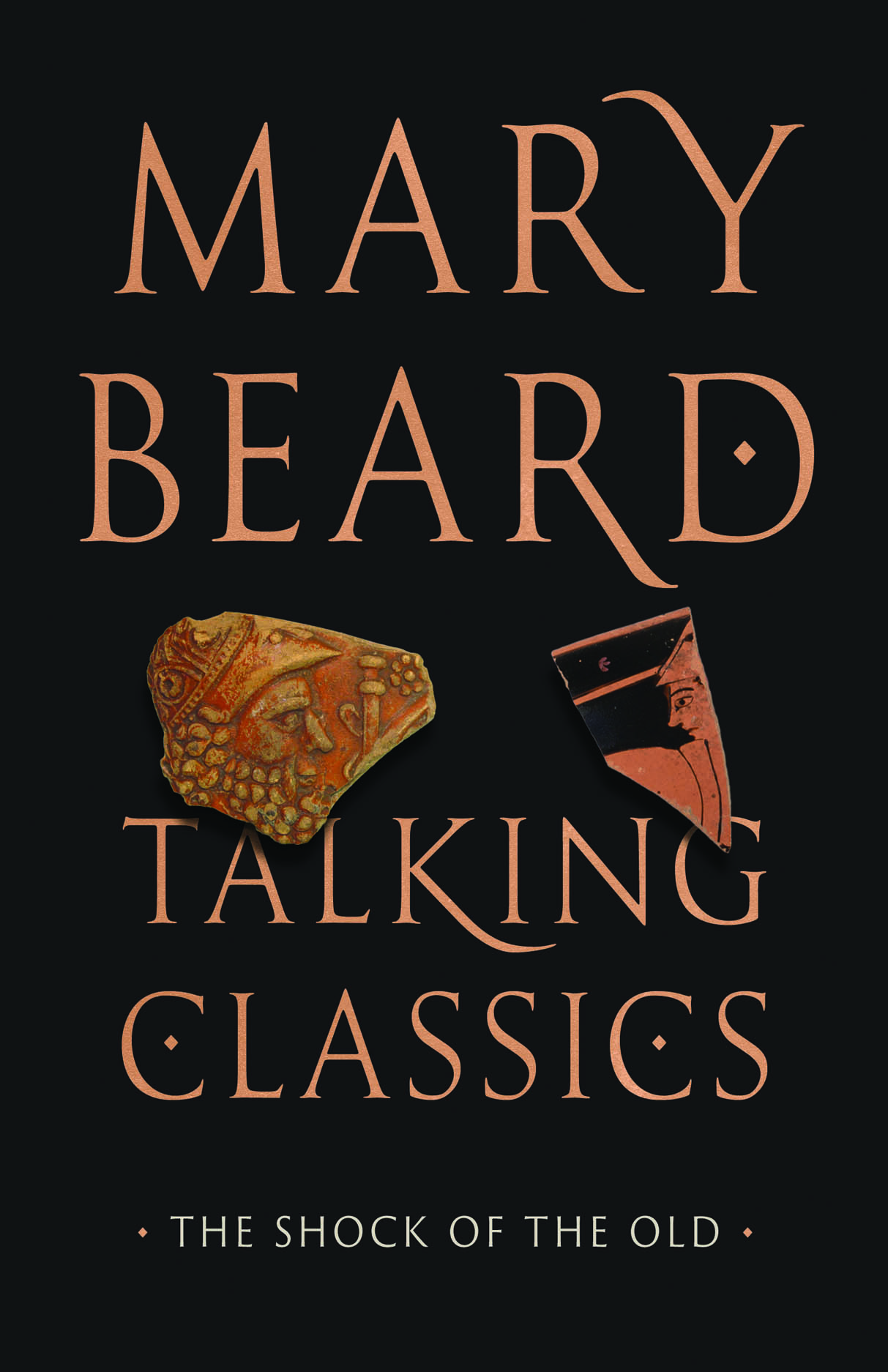
WW II by James Jones (Grossett & Dunlap), out of print
It’s kind of a cheat to pick a book that’s out of print, but it’s what we’re reading. The Newsjunkie publisher came into our office and dropped this tome on my desk. It landed with a substantial thump.
I knew James Jones from From Here to Eternity. I knew World War II from history, not to mention my Uncle Larry, who served as a quartermaster and gave me his uniform when I was a boy. I loved wearing it—and later loved that the draft had been suspended by the time I came of age.
What makes this book so special, especially to me, is that it’s not your run-of-the-mill history of the war. It is that, but it’s also illustrated with drawings by GIs. They run the gamut from Sad Sack cartoons making fun of military life to government propaganda, pinups, and sketches made in the heat or aftermath of combat.
As someone who loves to draw, it’s a pleasure to look at these pictures in oils, charcoal, pen and ink, and more. Some are expressive, others crude, but together they capture a side of warfare we’ve largely left behind since TV cameras joined soldiers in the jungles of Vietnam.
Drawings may not have the immediacy of film or video, but there is something the human hand captures that a camera cannot—a layer of interpretation, memory, and feeling between the event and the image. It’s largely a lost art, one unlikely to return, and I think our culture is poorer without it.– PL
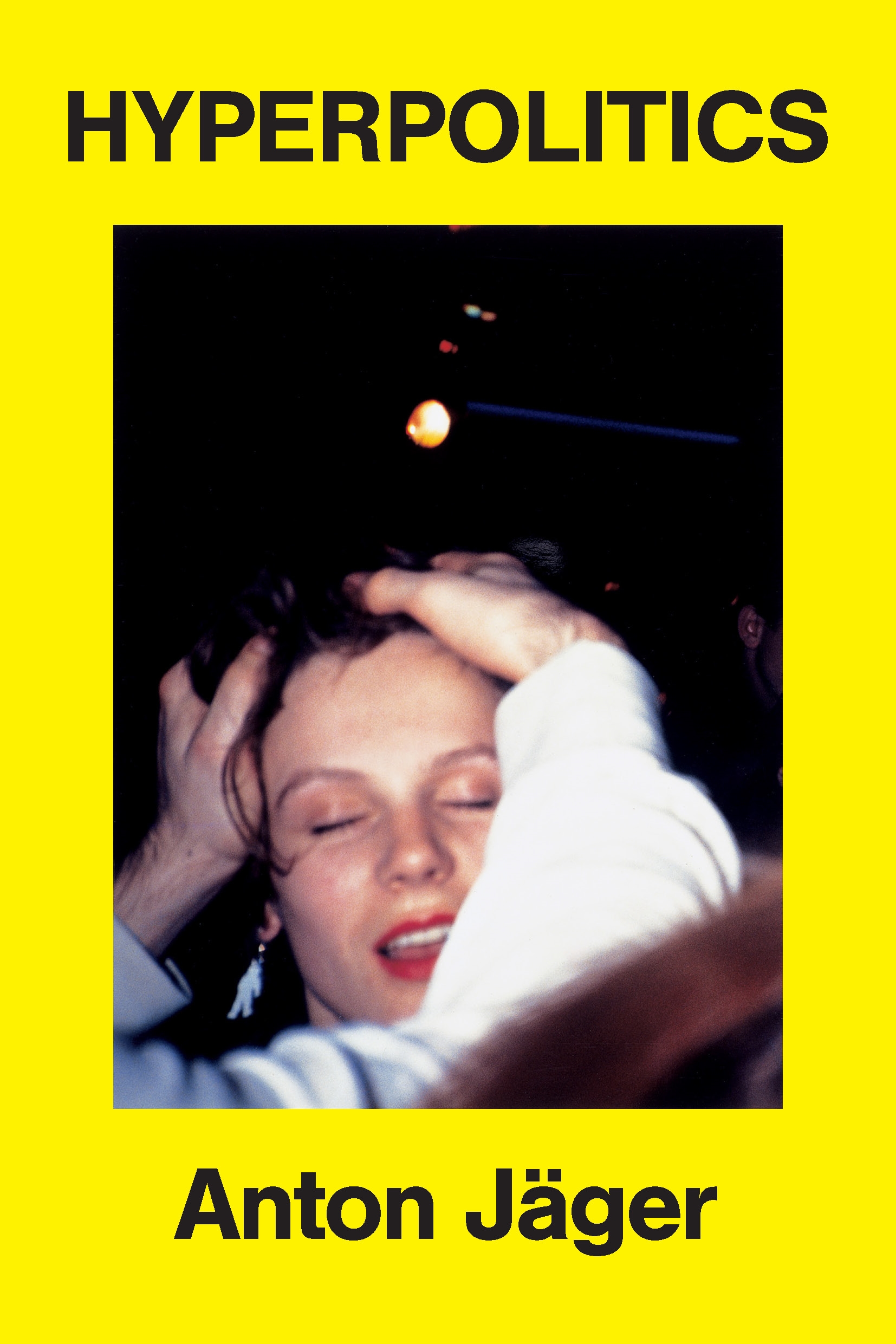
Hyperpolitics: Extreme Politicization without Political Consequences by Anton Jäger (Verso)
Newsjunkies can get lost looking for the next hit. They follow one breaking story after another without slowing down long enough to see the path those stories create. That’s why we need people like Anton Jäger, a historian of political thought, who can put the pieces together and show us the bigger picture. It’s not good. In Hyperpolitics, Jäger describes a period of intense political energy without the strong organizations needed to direct it. What do we get? Trump. Or rather, Trump is one especially ugly American expression of the problem—more symptom than cause. History never ended, despite the famous claim. According to Jäger, we moved from an era of mass politics, when political energy was matched by institutions capable of channeling it, into a post-political period after the Cold War, when both political participation and those institutions diminished. That gave way to anti-politics, as anger turned against the political establishment, and eventually to hyperpolitics: a world in which everything feels political, but little of that energy is converted into durable collective power. We live in a time when people are isolated, and without solidarity there is little power. Without collective power, money becomes both the rule and the ruler. Worse, apathy, exhaustion, and the daily struggle to scrape together enough resources to survive help keep this dystopian status quo in place. It’s enough to make you hyperventilate. – PL
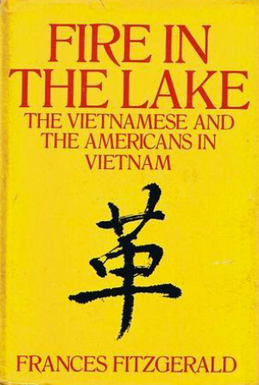
Fire in the Lake: The Vietnamese and the Americans in Vietnam by Frances FitzGerald (Black Bay Books)
Growing up as a boy in the 1960s meant that I was destined for a body bag. I read the daily papers my dad brought home from work (well, the comics section), caught glimpses of the war while channel surfing to lighter fare, and even wore one of the POW bracelets popular in the early 1970s. By the time I hit draft age the Vietnam War was over, in fact if not in myth. Theater marquees announced the latest big-budget take on the war and its casualties on both sides. I thought I knew the history, but I only feared it. Only recently have I been schooled by Frances FitzGerald, who covered the war primarily as a freelance journalist, focusing on Vietnamese society, politics, and the effects of the hostilities rather than daily combat. Her dispatches and essays appeared in prominent publications including The Village Voice, The New York Times Magazine, and The Atlantic. She published Fire in the Lake (the title, drawn from the I Ching, evokes revolution, chaos and the disruption of an established order) before the Vietnam War had even ended, and yet it reads as one of the most definitive and insightful take on that controversial conflict. As in most wars that the United States has waged since then, the issue revolves around a misunderstanding of culture and an overconfidence in superior firepower. This is a book that doesn’t get old because its message hasn’t been heard. – PL
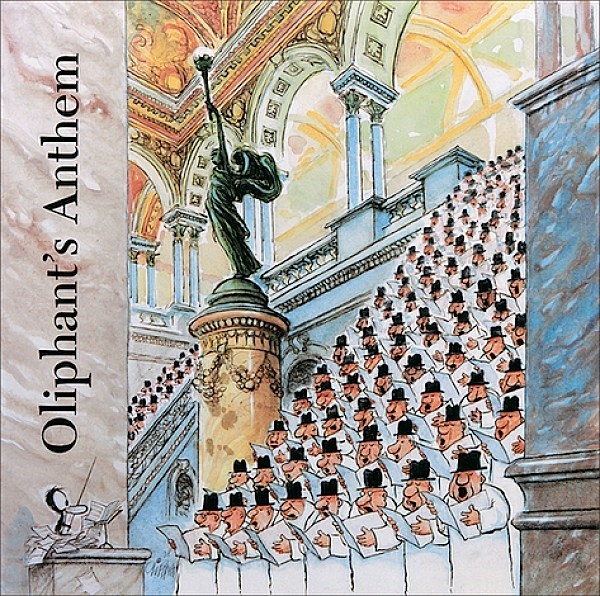
Oliphant’s Anthem By Pat Oliphant (Andrews McMeel Publishing)
Pat Oliphant is considered America’s best and most influential political cartoonist. True, with a caveat. He’s not American, but an Australian transplant. Maybe it took a foreign eye to capture the absurdity of our politics. But even more than his biting, satiric view is his style. Even if you’ve never seen one of his drawings, once you do they’ll be instantly recognizable. That’s because almost every political cartoonist after him coped that crosshatched look that harks back centuries to William Hogarth. But as this book, published alongside a special tribute exhibition at the Library of Congress, capturing over 25 years of his drawings, sculptures, and multi-media artwork, proves he has been often imitated, but rarely surpassed in wit and execution. For those who want more, a documentary called A Savage Art: The Life & Cartoons of Pat Oliphant is available on DVD and streaming. – PL
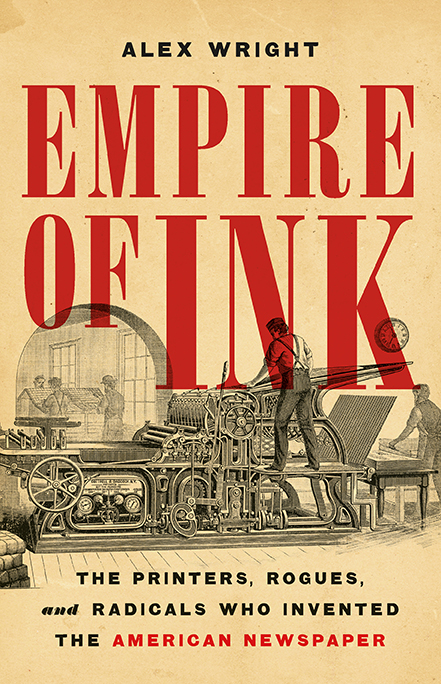
Empire of Ink: The Printers, Rogues, and Radicals Who Invented the American Newspaper by Alex Wright (Basic Books)
The sky is always falling. Chicken Littles have been clucking their fearful proclamations throughout history. You probably read about one in your local newspaper—that is, if you still get a physical paper. More people are getting their news online, but Alex Wright argues in Empire of Ink that technology has always disrupted industry. Remember Linotype? It revolutionized newspaper production. I'm old enough to remember its slow demise, as the production department for the weekly rag I edited shrank from a handful of craftsmen to a computer. Wright notes the loss of physical papers, quoting a grim statistic: two die each day. But he remains hopeful. Maybe he sees the same thing we do: community organizations delivering local news and paving the way to sustainable, trustworthy institutions. But aside from the doom—and maybe not the gloom—this book is chock-full of colorful stories about personalities and the history of newspapers from the Revolutionary War to the 19th century that will make a muckraker tear up with nostalgia for the good old days. Every newshound should sniff out this book and chew on it like the juicy bone it is. [Full review coming soon. — ed.] – PL
The News: A User’s Manual by Alain de Botton (Vintage International)
The news is failing at its mission, according to philosopher and essayist Alain de Botton. In The News: A User’s Manual, he argues that news producers generate as much frustration as understanding. Because journalists report with a tone of authority while leaving out much of a story’s context and nuance, readers receive only reductive summaries, like “the committee was faced with a difficult decision,” and are left with no grasp of the meeting’s actual dynamics or of the likely consequences of its decision. He argues that this kind of reporting directs frustration and anger not toward journalism’s limitations but toward the people named in the articles, who are often made to look simplistic, nefarious, or both. His prescription? “The news shouldn’t eliminate angry responses, but it should help us be angry for the right reasons, to the right degree, for the right length of time—and as part of a constructive project.”
De Botton makes one particularly stunning demand—one that should prompt reflection and action among newsjunkies everywhere. “Too many of the stories about the misdeeds of bad people seem strikingly devoid of interest in the one goal that should rightly underpin all reports of wrongdoing and chicanery: the ambition to help the nation flourish. These stories circle their prey without any interest in the evolution of public life; they aren’t trying to get accountancy, marriages, universities, immigration, or the tax system to go better. They are just inviting us to have a particular kind of fun.” By “fun,” de Botton means the pleasure of condemnation: the invitation to watch institutions and individuals fail without seriously considering how either might be improved.
His broader point is that journalism cannot avoid shaping public judgment simply by declining to acknowledge the values embedded in its choices. It is refreshing to see a writer demand that journalism acknowledge its civic purpose rather than hiding behind conventions that can make reporting appear detached from consequences. I find myself increasingly skeptical of neutrality as an overriding journalistic ideal, particularly because public figures have learned to exploit both-sidesism and false equivalence to their advantage.
That does not mean abandoning fairness, verification, or intellectual independence. It means recognizing that accurately describing an unequal or dishonest situation does not always produce a symmetrical account. Good journalism need not restrict itself to presenting disconnected facts at arm’s length and leaving readers to determine their significance unaided. Informing the public is the goal. When the available evidence clearly supports a conclusion, journalists should not be afraid to state it plainly.
Alain de Botton offers a thoughtful critique of journalism’s habits, especially its lack of context, its appetite for scandal, and its reluctance to articulate a constructive civic purpose. Recommended. – GJW
Odyssey by Homer, translated by Stanley Lombardo (Hackett Publishing Company, Inc.)
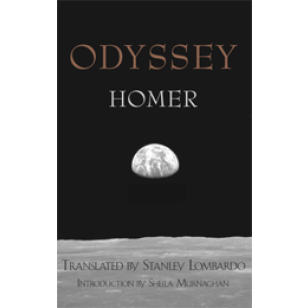
Christopher Nolan’s adaptation of Homer’s Odyssey was released last week. I didn’t see it. Neither did a lot of people online, though they have opinions (what a surprise). Those concerns, to put it lightly, have to do with authenticity. The armor, the boats, the casting – they’re all wrong! It’s a ridiculous criticism of what is essentially the Harry Potter of its time. Homer, or the generations of oral bards behind him, would laugh. Writing the story down may have fixed one version of it, but the original tradition was always changing. In fact, the modern use of classical texts is rife with interpretation. It is, after all, a fantasy, and any call for authenticity raises the question: authentic to what? Whether the movie captures the spirit of this great story is for movie critics and the hordes of moviegoers selling out theaters to determine. All I hope is that there are a few out there who return to the source material. I’d recommend Stanley Lombardo’s translation. It’s the one I read and it’s very readable. The cover has a picture of Earth as seen from the Moon. That image in a picture is the soul of this otherworldly tale. For those who read on, welcome to the uncanny world of Greek literature. – PL
The Freaks Came Out to Write: The Definitive History of The Village Voice, the Radical Paper That Changes American Culture by Tricia Romano (Public Affairs)
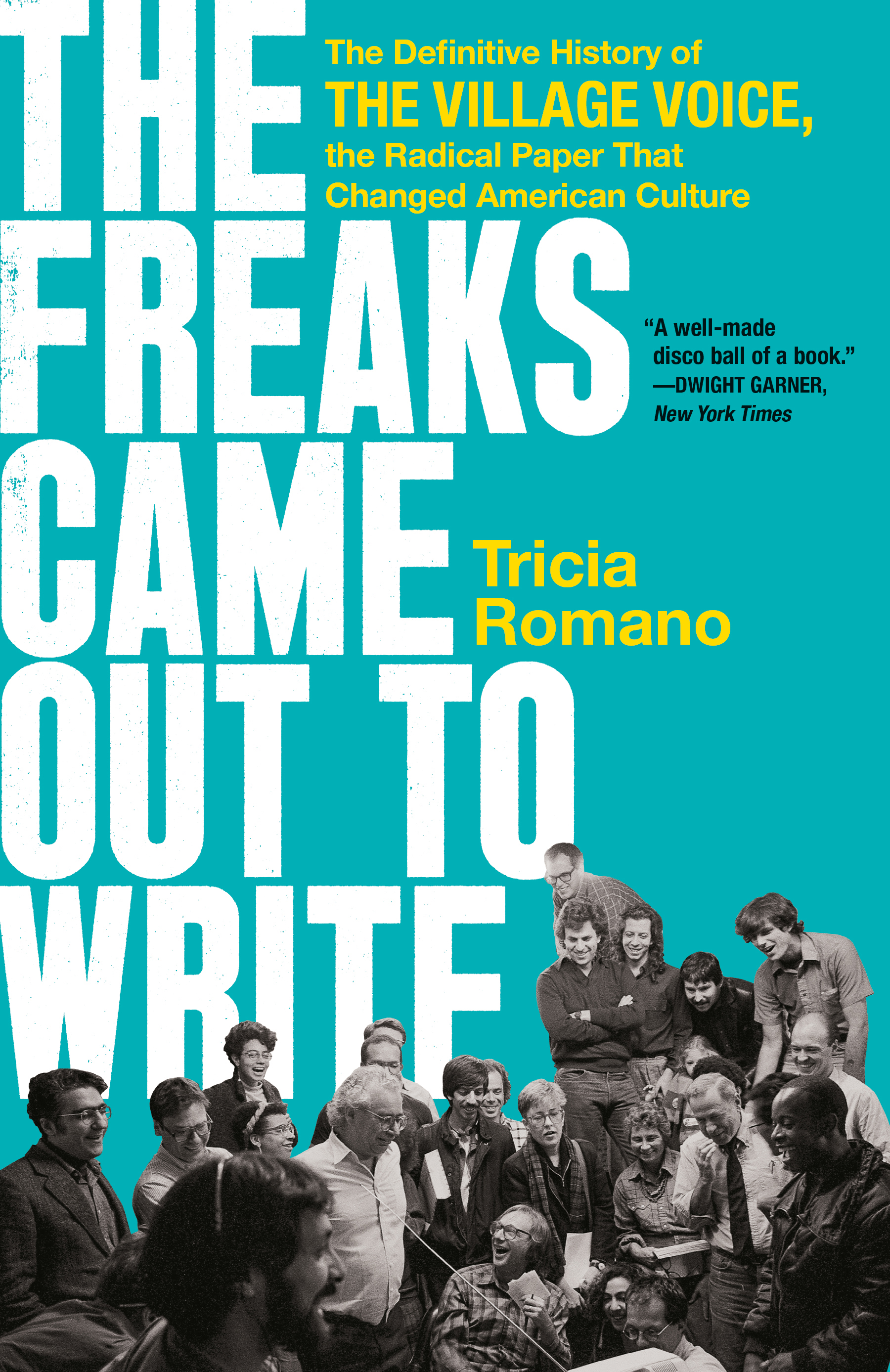
New York City was hitting its stride by the mid-1950s when The Village Voice launched, but the paper really took off during the 114-day newspaper strike in late 1962. It was the only game in town, and what a game it played. Political reporting with an edge, arts and music coverage of a burgeoning scene that writers are still plotzing over. That strike ended a few days before my birthday. While I grew up with The New York Times and The Post, it was in my teen years that The Voice became my paper of record. There were cartoons. But most importantly, the listings. So many great bands to see live everywhere from dives to bandshells in the park. By the mid-1980s, when Voice music columnist RJ Smith wrote a glowing review of my band’s graveyard set at CBGB, I’d made it. Top of the world, ma! RJ Smith is one of nearly 200 Voice contributors who make up the lively oral history of the paper. There was so much I simply missed because of myopic interests. Thanks to Tricia Romano’s The Freaks Came Out to Write, my vision has improved. What I see is a crazy patchwork of weirdo obsessives and to say more would ruin the serendipitous page-turning wonderment of reading this tome. While the Voice is hardly heard in the cacophony of media bombarding us today, and it doesn’t help that the print run shuttered in 2017, its digital footprint remains active. It’s ironic that a periodical that once got you off your ass is now on a laptop. That’s New York, the city that never sleeps. Read this book and dream on. – PL
AP Stylebook, 58th Edition, published by the Associated Press
The plot stinks. The characters are nonexistent. But it’s consistent. Edition after edition, the AP Stylebook comes out and guides reporters and editors through a jungle of type to an oasis of professionalism. Nobody reading the paper notices, but that’s the charm of this bible. It’s the invisible glue that holds together an industry. We’d be lost in chaos, thrown into the void without it. The AP Stylebook tells you how to abbreviate states, which numbers are printed numerically and those that are spelled out. Trivial? Fool! The news is old the moment the ink hits the newsprint, but the AP Stylebook is a living, breathing, growing expression of the free press. Yes, it’s underappreciated, if acknowledged at all outside the press room, but it sets the tone, a standard for us all to strive for. Find a copy and get writing! – PL
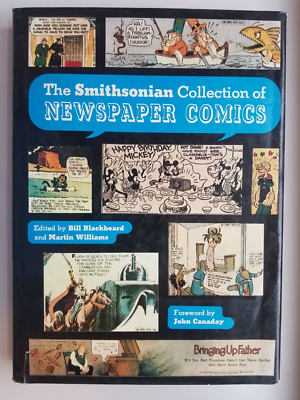
The Smithsonian Collection of Newspaper Comics edited by Bill Blackbeard and Martin Williams (Washington: Co-published by Smithsonian Institution Press and Harry N. Abrams)
What would newspapers be without comics? I never would have been interested. Growing up, my dad would bring home a couple of the local dailies. The front pages charted the deepening quagmire of the Vietnam War. Even though I was years away from the draft, it was a given in my immature mind that I would be sent off to the jungle to die just when my life was about to begin. The New York Times didn’t help. It didn’t have a comics section. All the news that’s fit to print my ass! Sure, I could admire Al Hirschfeld’s theater drawings, but that only whet my artistic whistle. Thankfully, he also carried home a copy of the New York Post. This was back when it was the liberal, working-class paper, but he was more interested in its sports coverage. I followed Peanuts, Dick Tracy, Mutt and Jeff, Blondie, Hi and Lois, Beetle Bailey, The Wizard of Id, B.C., Doonesbury, The Lockhorns, et al. It wasn’t until I was 13, having a bar mitzvah and now being a man, that I was introduced to the scope of newspaper comics. I had no idea. An art director friend of the family who nurtured my budding artistic talents, gifted me with a copy of The Smithsonian Collection of Newspaper Comics. It was a seminal experience in my life. Little did I realize how long some of these strips had been published or how American these panels were. From the Yellow Kid to Krazy Kat, cartoonists were like movie stars, living in mansions, but humbly working their craft without pretensions. Some even used toothpicks dabbed in ink rather than the bourgeois steel-nib dip-pen. But it was the artistry, humor, and storytelling that truly won me over. Looking back, the newsprint ink that stained my fingertips feels like the medium's last gasp. Newspaper comics are hanging on alongside the newspapers that gave them life, and I wish them well. But if you want to experience their golden age, find a used copy of this remarkable volume—or explore the preserved pages on the invaluable Internet Archive—and rediscover the birth of an American art form. – PL
The Ministry for the Future (Hachette Book Group) by Kim Stanley Robinson
And now for something completely different, but maybe not that far off the beaten path of this blog. Kim Stanley Robinson's The Ministry for the Future begins with a devastating heat wave in India that kills millions, then follows the decades-long global effort to confront the climate crisis that follows. Readers of our Prairie Fire project might not think of this scenario as fiction, let alone science fiction, but a peak at a tomorrow that’s fast approaching. Called the “The best science-fiction nonfiction novel I’ve ever read” by Jonathan Lethem, Robinson examines how governments, scientists, activists, economists, and ordinary citizens might respond when climate change becomes impossible to ignore. The result is part novel, part thought experiment, and one of the most ambitious works of climate fiction written in recent years. My son has just bought a mini-eReader and has been working his way through the science fiction canon, attracted to narratives with a dystopian bent. This novel steps in that direction, but moves into a more hopeful future of collective action against climate change. It might be enough to get his generation (and mine) off our butts to address the elephant in the room (no dig against republicans, democrats aren’t doing much either). – PL
Empire of AI: Dreams and Nightmares in Sam Altman's OpenAI (Penguin Random House) By Karen Hao
One of the first major books to examine artificial intelligence not as a technological marvel but as a global industrial system. Hao draws on years of reporting, following the vast supply chain behind AI. That includes the data centers that consume enormous amounts of energy and water, which have been causing controversy of late, to the low-paid workers who label training data and moderate content. This is an industry built on hype, labor, natural resources, and political power. Hao writes that technology does not exist apart from society. She argues that the race to build ever-larger AI models is reshaping economies, communities, and public institutions, often without meaningful public oversight. The book is a deeply reported look at the human and environmental costs hidden behind the industry's promises of progress. – PL
Murder the Truth: Fear, the First Amendment, and a Secret Campaign to Protect the Powerful (Mariner Books) by David Enrich
Most people who care about press freedom know New York Times Co. v. Sullivan. The 1964 Supreme Court decision established that public figures must prove "actual malice" to win a libel suit, a standard that allowed journalism to cover civil rights, Watergate, Vietnam, and 40 years of corporate wrongdoing without being buried in litigation. David Enrich, the business investigations editor at the Times, began noticing around 2022 that the legal threats against his team were increasing sharply in volume and frequency. When he looked further, he found journalists across the country reporting the same thing. This was not random suits, but a pattern. Murder the Truth is his account of what he found: a coordinated, well-funded campaign by powerful conservatives, with the explicit backing of at least two Supreme Court justices, to use the courts as a slow-motion weapon against the press by overwhelming individual reporters and small newsrooms with litigation costs they cannot absorb. Enrich grounds the legal argument in specific human cases rather than constitutional theory. The story of Lauren Chooljian, a reporter at New Hampshire Public Radio who investigated a wealthy rehab center owner's alleged sexual misconduct and was immediately met with high-priced legal threats, is more chilling than any abstract account of First Amendment erosion could be. The campaign doesn't need to win in court to win — it needs only to make reporting on powerful people expensive enough that editors start asking whether the story is worth the risk. Given that ABC News recently settled a defamation suit with Trump rather than fight a case most First Amendment lawyers believe it would have won, the answer to that question is already changing. Watching the CBS/60 Minutes situation unfold in real time, this is the legal framework that explains it. – PL
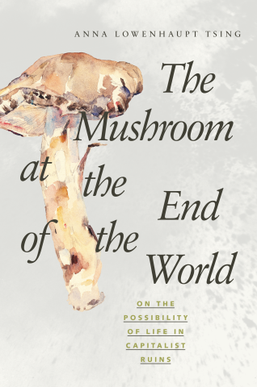
The Mushroom at the End of the World (Princeton University Press) by Anna Lowenhaupt Tsing
Anna Lowenhaupt Tsing’s The Mushroom at the End of the World: On the Possibility of Life in Capitalist Ruins is one of those rare nonfiction books that quietly changes the way you look at modern systems. Built around the global trade in the matsutake mushroom — a delicacy that grows in damaged forests and disturbed landscapes — the book becomes a much larger meditation on precarity, collapse, labor, ecology, and survival after industrial disruption. Tsing moves between Oregon forests, Japanese markets, refugee labor networks, and ecological history, showing how communities and ecosystems adapt inside the ruins of broken economic systems rather than outside them. What makes the book especially relevant now is its rejection of the idea that progress is orderly or guaranteed. Tsing argues that modern life increasingly unfolds through unstable supply chains, fragmented institutions, and improvised forms of cooperation. The result is a work that feels deeply connected to many of the themes Newsjunkie has been exploring: endangered knowledge systems, fragile infrastructures, informal networks of preservation, and the uneasy relationship between technological progress and institutional decline. It is dense in places, but unusually rewarding for readers interested in systems thinking, archives, environmental history, and the hidden structures that hold modern life together. – PL
The Unmaking of the American University by Nicholas Lemann (New Yorker feature, 2026)
Nicholas Lemann’s The Unmaking of the American University is a sprawling New Yorker essay that traces how America’s research universities became deeply dependent on federal funding while simultaneously drifting further from public trust. The result, he argues, is a system uniquely vulnerable to political pressure. Through reporting on Johns Hopkins, Columbia, Brown, Harvard, and other institutions caught in the Trump administration’s campaign against higher education, the piece documents a slow transformation of universities from relatively autonomous centers of research into institutions increasingly forced to negotiate for survival. But Lemann doesn’t reduce the crisis to a simple partisan story. He examines not only the administration’s pressure campaigns—grant suspensions, ideological demands, and threats to research funding—but also the contradictions universities themselves helped create: elite exclusivity paired with claims of public service, growing administrative bureaucracy, and dependence on federal money without durable political support. The essay ultimately argues that something larger than academia is at stake. Scientific research, public health, historical scholarship, and democratic institutions all rely on knowledge systems that were once assumed to be stable. Lemann suggests that assumption may no longer hold. – PL

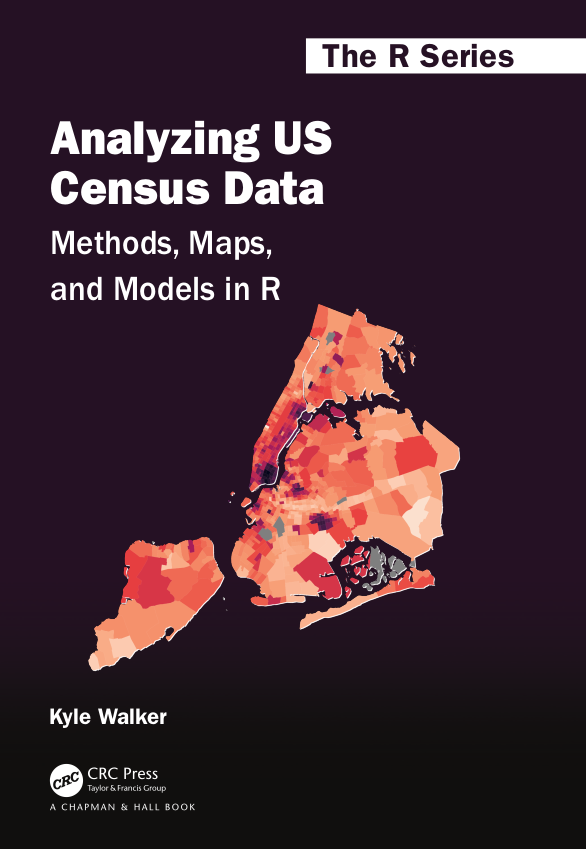
Analyzing US Census Data: Methods, Maps, and Models in R by Kyle Walker (CRC Press)
Kyle Walker’s Analyzing US Census Data: Methods, Maps, and Models in R is ostensibly a technical guide, but it also reads as a quiet defense of public data itself. Walker walks readers through the mechanics of accessing, mapping, and interpreting Census and American Community Survey data using R, with an emphasis on transparency and reproducibility. For journalists, researchers, and civic technologists, the book offers a practical roadmap for turning raw government data into something legible and useful. What makes the book especially timely is how clearly it demonstrates the value of maintaining robust public information systems. Walker’s work depends on decades of federal investment in data collection, geographic infrastructure, and open access. At a moment when public datasets are becoming politically contested—and in some cases disappearing altogether—Analyzing US Census Data doubles as both a technical manual and a reminder of how much modern research, journalism, and policymaking rely on stable public data infrastructure. – PL
Amusing Ourselves to Death: Public Discourse in the Age of Show Business by Neil Postman (Penguin Random House)
Neil Postman’s Amusing Ourselves to Death is a prescient media critique and a warning few took seriously at the time of its publication in 1985. Writing in the age of television, Postman argues that public discourse in America has been reshaped not by censorship, but by entertainment. News, politics, religion, and education, he suggests, have all been reformatted to fit the logic of show business. That is, make it fast, visual, and emotionally engaging, but often shallow. Serious ideas continue to surface, but that they are delivered in ways that make sustained, critical thinking harder to maintain. The book’s thesis extends beyond television into the digital age. Postman’s concern wasn’t just about screens, but about a culture that prioritizes engagement over substance. In that sense, Amusing Ourselves to Death reads today as a blueprint for understanding everything from cable news to social media feeds. For anyone thinking about journalism, information, or the public’s relationship to truth, it’s a sharp, unsettling reminder that the medium doesn’t just carry the message—it shapes what kinds of messages can survive. – PL
Evicted: Poverty and Profit in the American City by Matthew Desmond (Crown)
Matthew Desmond’s Evicted is a rare work of journalism that manages to feel both intimate and systemic at the same time. Following eight families in Milwaukee, Desmond documents the day-to-day realities of housing instability with a level of access and detail that reads almost like a novel—but every scene is deeply reported. What emerges is a clear, unsettling argument: eviction isn’t just a symptom of poverty, it’s a driving force behind it. By embedding himself in the lives of both tenants and landlords, Desmond shows how precarious housing shapes everything from employment to education to mental health. What makes Evicted especially powerful is its restraint. Desmond doesn’t lean on overt moralizing; instead, he builds his case through accumulation—missed payments, court dates, forced moves—until the structural failures become impossible to ignore. It’s journalism that trusts the reader, grounded in data but carried by human stories. For anyone interested in inequality, policy, or the lived experience behind economic statistics, Evicted is essential reading. – PL
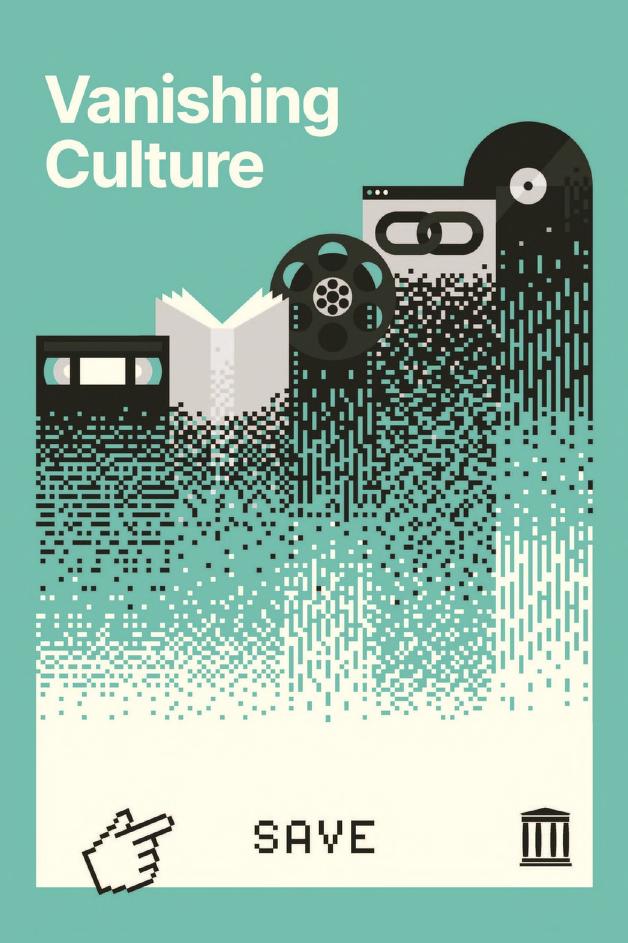
Vanishing Culture: A Report on Our Fragile Cultural Record by Luca Messarra, Chris Freeland, and Juliya Ziskina (Internet Archive)
This clearly-written, essential book from The Internet Archive quietly screams to us that the future of history is in danger. Explaining what is in plain sight yet poorly understood, the IA team of Messarra, Freeland, and Ziskina identifies the forces (mostly corporate) that exploit quirks in copyright law to restrict and sometimes bury access to intellectual works intended for public benefit. The theme is tilted toward reform, care and custodianship, not scolding. That being said, the facts are bleak, a litany of digital documents that may disappear forever if matters aren't addressed soon. Delightfully, apart from the urgent warnings, there is much to inspire us within a rich appendix of tales of preservation, of typeface ephemera, 50's television shows, early social media, digital queer culture, filmstrips and other things we should not forget. Get-able free from Internet Archive, but why not splurge and get the trade paperback edition from Better World Books instead? — GJW
Information and Society by Michael Buckland (The MIT Press Essential Knowledge Series)
I have been designing information systems since the 1970s. Professor Buckland's 200-page book dives fearlessly into the most opaque questions on the nature of information, giving us a no-nonsense grasp of the topic. I learned much, and expansive vocabulary and references opened the door to much more. Given the ever-expanding role of documents, records, messages, and pure data in our lives, Information and Society is more than a road map; it's a lifeline. – GJW
Miss Lonelyhearts by Nathaniel West (New Directions Publishing)
Miss Lonelyhearts feels less like a novel and more like a bad signal you can’t quite tune out—funny, cruel, and a little too close to whatever passes for reality. Nathaniel West drops us into a newsroom where suffering arrives daily in the mail, sorted, skimmed, and turned into content. The advice columnist at the center of it all wants to feel something real, but the machinery of media—then as now—demands performance over sincerity. What makes the book linger is how little has changed: despair packaged for consumption, empathy stretched thin, and a writer caught between the urge to help and the knowledge that he’s mostly just feeding the cycle. It’s bleak, sharp, and, somehow, still absurdly entertaining. – PL
We Are Bellingcat by Eliot Higgins (Bloomsburg Publishing)
We Are Bellingcat by Eliot Higgins tells the story of how a loose network of journalists, researchers, and online sleuths transformed open-source investigation into a powerful tool for accountability. The book follows Bellingcat’s rise from a blog into a globally recognized investigative collective, using publicly available data—satellite imagery, social media posts, flight records—to uncover war crimes, state-sponsored attacks, and disinformation campaigns. At its core, it argues that in an era of secrecy and manipulation, the ability to analyze and verify open data has become one of the most effective ways to challenge power and reconstruct truth. – PL
The Iliad by Homer (Hackett Classics)
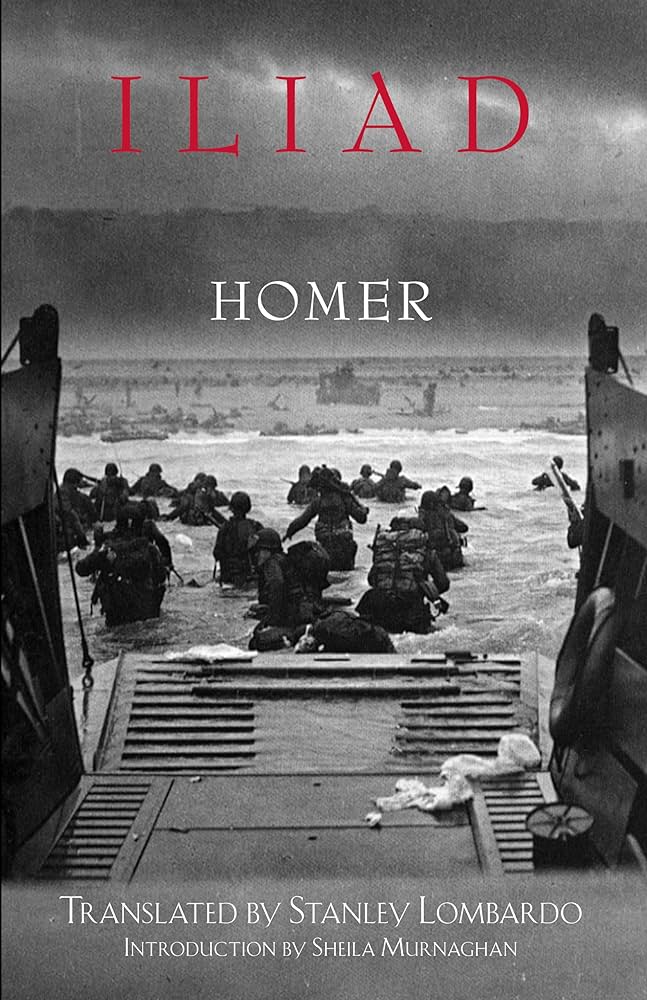
Most people tend to prefer the Odyssey over the Iliad, the second in Homer’s epic poems. Kirk Douglas played Odysseus in the 1954 film, and there’s a new version being released this summer. We’ll see if it’s the blockbuster that Universal Pictures hopes it is. That’s a good bet, as the film is helmed by Christopher Nolan. But here at Newsjunkie we’d rather see the Iliad adapted. No, strike that. We’d rather people read it or, even better, recite it. The original was part of an oral tradition and poetry is best heard. However you consume it, there’s much that a modern audience can still get from this classic of the Western Canon. For one, the Hackett Classic edition is translated by Stanley Lombardo in prose that is contemporary without sacrificing the epic nature of the work. The cover reflects this, being illustrated with a historic photograph from the landing on Normandy Beach on D-Day during WWII. As our country engages in another conflict, we can see what Homer saw millennia ago: the senseless carnage of war. Simone Weil wrote a famous essay, The Iliad, or the Poem of Force (1940/1941). It shows how when violence is unleashed it turns anyone subjected to it into a thing. That is, we believe we can control force, but quickly learn it only dehumanizes everyone and leaves a sea of corpses in its wake. It was true then and it’s true now. – PL
Ghosting the News: Local Journalism and the Crisis of American Democracy by Margaret Sullivan (Columbia Global Reports, 2020)
Margaret Sullivan spent years as the Washington Post's media critic watching American journalism hollow itself out from the inside, and this slim, urgent book is the distillation of everything she witnessed. Ghosting the News traces the collapse of local news across the country: the shuttered papers, the gutted newsrooms, the communities left with no one covering city hall, the school board, the county courthouse. Sullivan is a clear-eyed and unsentimental guide, and she resists the temptation to make this a story about nostalgia. The loss she's documenting isn't about sentiment. It's about function: who tells people what their government is actually doing when no one is watching? What makes the book essential reading right now — and particularly resonant for anyone following what's happened to the Voice of America — is Sullivan's argument that the disappearance of journalism doesn't create silence. It creates a vacuum that gets filled. Misinformation, PR dressed up as news, propaganda both foreign and domestic: these don't struggle to find audiences in news deserts. They thrive in them. Sullivan wrote this before the current assault on federal media institutions, but her framework maps almost perfectly onto the present moment. When a trusted, independent signal goes dark, something else takes its place, which it is almost never better. Short enough to read in a single sitting, sharp enough to stay with you considerably longer. – PL
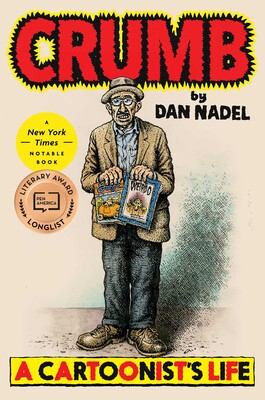
Crumb: A Cartoonist’s Life by Dan Nadel (Simon & Schuster)
Robert Crumb is not a journalist. He’s not even a writer. The man who is best known for the birth of the Sixties' underground comix explosion is a cartoonist. What’s he doing on Newsjunkie? Few people have captured the zeitgeist better, or done it their way. In a sense, Crumb was an embedded journalist in the Haight-Ashbury scene in San Francisco during the Summer of Love, and you’ll not find a more honest, warts-and-all portrayal of hippiedom. Crumb’s throwback style—a combination of early American newspaper comics and Disney funny-animal comic books—is taken to disturbing destinations, but always tethered by his talents as a draftsman and storyteller. His reportage isn’t limited to a time and place in history, but captures the absurdity of life—specifically his life and exploding libido. He also explores race relations and the battle of the sexes more honestly than most have the courage to do. That’s got him into a lot of trouble, then and now, which Dan Nadel doesn’t shy away from in the book. In fact, Crumb only agreed to work with Nadel if the author promised not to write a hagiography. Since this biography comes years after the excellent documentary on Crumb and his family, most of whom seem to be in competition with him for weirdest member, it’s fair to ask if the book breaks any new ground. It does. Anyone interested in one of the greatest artists of our time—and a chronicler of our country’s and his neuroses—will love this well-written and deeply researched biography. – PL
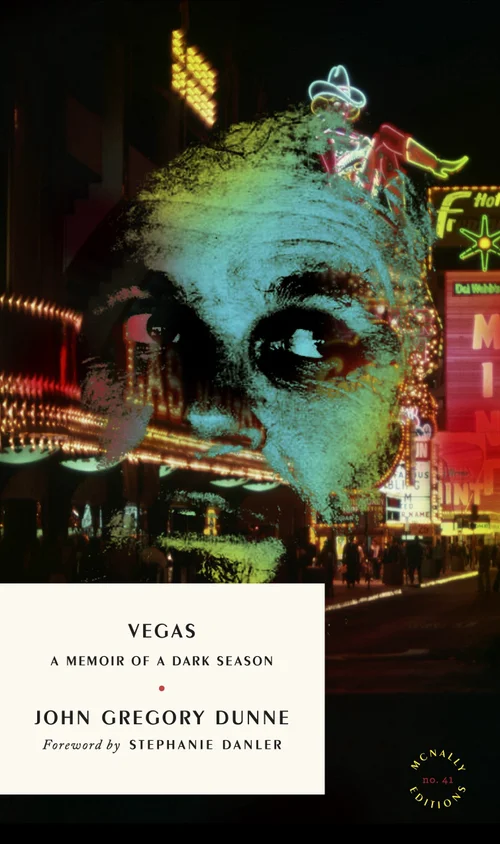
Vegas: A Memoir of a Dark Season by John Gregory Dunne (McNally Editions)
John Gregory Dunne’s Vegas: A Memoir of a Dark Season (1974) reads less like a travel book about Las Vegas than a dispatch from a personal and cultural breakdown. Dunne opens the story by fleeing Los Angeles for the Nevada desert during what he calls the “summer of my nervous breakdown,” taking refuge in a cheap apartment off the Strip while trying to write his way through a period of anxiety, marital strain, and professional uncertainty. What follows is a strange hybrid of memoir, reportage, and noir character study, populated by gamblers, comedians, prostitutes, and hustlers who inhabit the margins of the city’s gaudy entertainment machine. The book blurs the line between autobiography and journalism, using the author’s encounters with these figures to capture a gritty portrait of Vegas at a moment when the American dream seemed to be fraying. What makes Vegas endure is its clear-eyed, almost anthropological attention to the human stories behind spectacle and excess. Dunne approaches Las Vegas not as a playground but as a kind of social laboratory—one where the anxieties of the early 1970s, from economic insecurity to personal dislocation, play out in miniature. Critics have noted that the book’s power lies in its mix of dark humor, brutal honesty, and close observation of the city’s characters and rituals. In that sense, Vegas feels like a piece of literary journalism disguised as a memoir: a writer wandering through a morally ambiguous landscape, collecting stories that reveal as much about America as they do about himself. For readers interested in the intersection of culture, politics, and the strange corners of the American experience, Dunne’s account still feels uncannily relevant. – PL
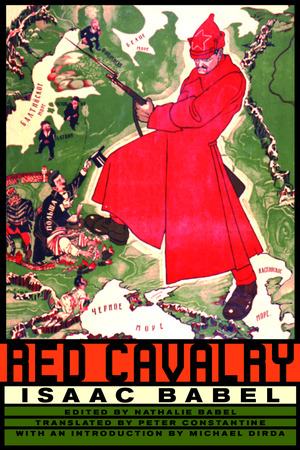
Red Cavalry by Isaac Babel (W W Norton & Company)
Before “embedded reporting” was a term, Isaac Babel was riding with the Red Army’s Cossack cavalry in 1920, filing dispatches while quietly observing the brutal contradictions of revolution. Red Cavalry, his searing collection of short stories drawn from that experience, reads like war correspondence stripped of illusion. Babel’s narrator — a Jewish intellectual adrift among swaggering soldiers — documents villages burned, civilians terrorized, and ideology colliding with reality. The prose is lyrical, compressed, and unsparing. It feels less like propaganda and more like a witness struggling to reconcile belief with bloodshed. For journalists, Red Cavalry is both a master class and warning. Babel understood that specificity carries more truth than slogans, and that style can reveal what official narratives conceal. His refusal to romanticize power ultimately cost him: arrested under Stalin in 1939, he was executed the following year. The stories survived. In an era of blurred lines between reporting and rhetoric, Babel reminds us that bearing witness is precarious work — and that telling the story as it is can be an act of quiet defiance. – PL
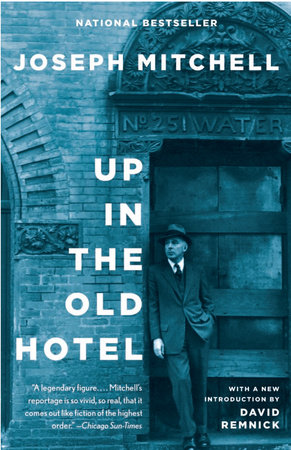
Up in the Old Hotel by Joseph Mitchell (Penguin Random House)
Joseph Mitchell’s Up in the Old Hotel feels almost subversive in 2026. First published in 1992, the collection gathers his decades of reporting for The New Yorker, chronicling oyster shuckers, Bowery proprietors, waterfront preachers, small-time schemers, and men who claimed to have not bathed in years. Mitchell didn’t chase headlines; he built worlds. His subjects were often obscure, marginal, or one scandal away from vanishing. What he practiced wasn’t access journalism or hot takes — it was immersion, patience, and an almost radical attention to people the city had already decided didn’t matter. Living in the time of influencer-era reporting and algorithm-driven outrage cycles, Mitchell reads like a rebuke. He lingered. He returned. He let people talk themselves into complexity rather than flattening them into symbols. At a moment when journalism often feels optimized for speed and virality, Up in the Old Hotel reminds us that the most enduring reporting isn’t reactive — it’s observational. Mitchell understood something we risk forgetting: institutions change, platforms mutate, but the real story is almost always found in the quiet corners, in the rooms above the noise. – PL
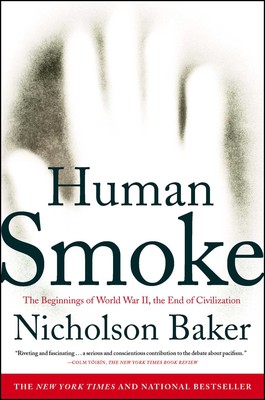
Human Smoke: The Beginnings of World War II, the End of Civilization by Nicholson Baker (Simon and Schuster)
Nicholson Baker’s Human Smoke is less a conventional history of World War II than a stark, documentary collage of the years leading up to it. Composed almost entirely of chronologically arranged newspaper items, speeches, diary entries, and government memos, the book strips away hindsight and heroic mythmaking. Baker foregrounds pacifists, diplomats, and dissenters who warned against escalation, while casting a critical eye on figures like Churchill and Roosevelt. The cumulative effect is unsettling: war appears not as destiny, but as a chain of political decisions, miscalculations, and moral compromises. What makes Human Smoke linger is the alternate history it quietly sketches. By immersing readers in the uncertainty of the 1930s, Baker suggests that another path — fragile, improbable, but real — once existed. Peace was not inevitable, but neither, he implies, was total war. Whether you see the book as a necessary corrective to triumphalist narratives or as a provocative overreach, it forces a reconsideration of inevitability itself — and of how easily civilization can tip into catastrophe. – PL
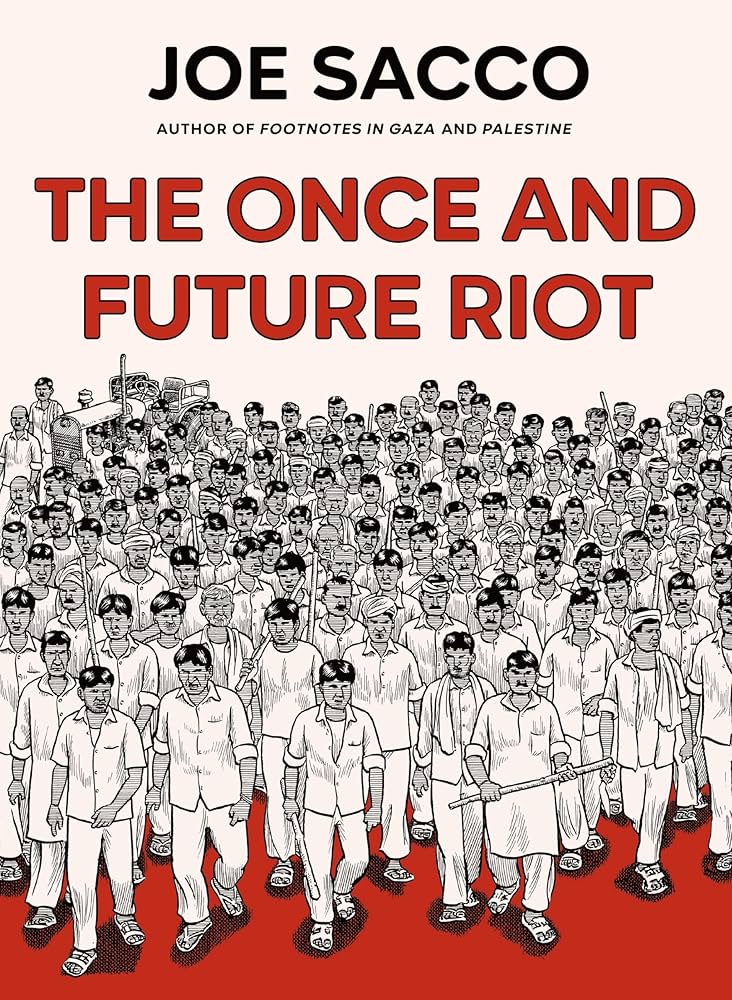
The Once and Future Riot by Joe Sacco (Metropolitan Books, Henry Holt & Company)
In this humble scribbler’s opinion, there is no greater art form than comics, which are sequential drawings. But the form more broadly encompasses cartooning in all its varieties and firmly earns its place in the Western canon. Comics unite art and literature in a discipline expansive enough to contain both the surreal minimalism of Ernie Bushmiller’s Nancy and the deeply researched reportage of Joe Sacco. While not exclusively a journalist, he is best known for works such as Palestine, Days of Destruction, Days of Revolt (with Chris Hedges), War on Gaza, and now The Once and Future Riot. In this latest book, Sacco ventures into new territory—India, and specifically the 2013 Muzaffarnagar riots. Through interviews with people on both sides of the violence, Hindu and Muslim, he illustrates how communal unrest unfolds. Like Simone Weil’s observations in her influential essay on The Iliad, Sacco shows how unleashed force becomes uncontrollable, reducing both perpetrators and victims to objects in its wake. Look for an interview with Joe Sacco in Newsjunkie soon. – PL
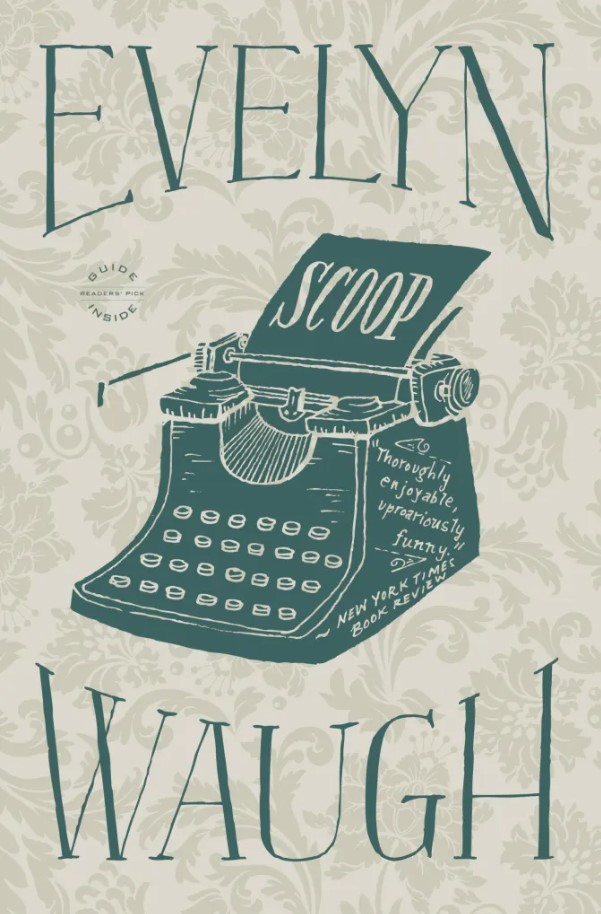
Scoop by Evelyn Waugh (Black Bay Books)
Scoop (1938), Evelyn Waugh’s brilliantly sharp satire of journalism, follows the absurd rise of William Boot, a timid and wholly unqualified nature columnist who is mistakenly sent abroad to cover a civil war in the fictional African country of Ishmaelia. What begins as a bureaucratic error becomes a biting comedy of press arrogance, competitive sensationalism, and the manufactured nature of foreign correspondence. Waugh, drawing on his own experience reporting in Abyssinia, skewers the self-importance of major newspapers and the way “news” is often shaped more by metropolitan expectations than by reality on the ground. Still wildly funny and surprisingly relevant, Scoop remains one of the most enduring literary portraits of journalism’s vanity, chaos, and occasional accidental truth. – PL
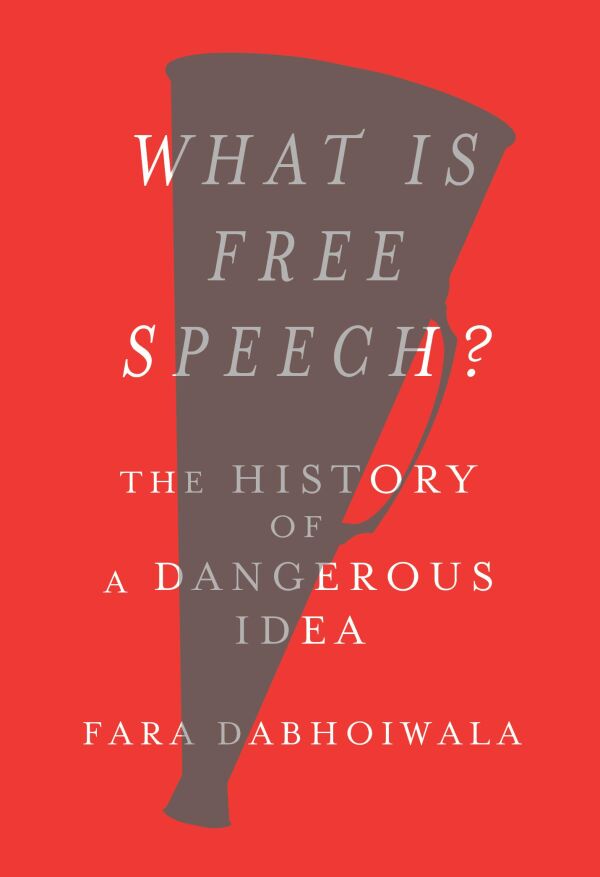
What Is Free Speech? The History of a Dangerous Idea (Harvard University Press) by Fara Dabhoiwala
In What Is Free Speech?, historian Fara Dabhoiwala delivers a sweeping, lucid, and deeply humane history of an idea that is far older—and far more contested—than modern democracies often admit. Ranging from early modern Europe to the Atlantic world, Dabhoiwala shows that free speech was not born fully formed in the Enlightenment but emerged through messy struggles involving religion, censorship, printing, and popular dissent. What makes the book remarkable is its refusal to treat free speech as an abstract ideal; instead, it is grounded in real people, real conflicts, and the constant tension between authority and expression. Elegantly written and intellectually generous, the book reminds readers that free speech has never been absolute, never been easy, and has always depended on social trust as much as legal principle. – PL
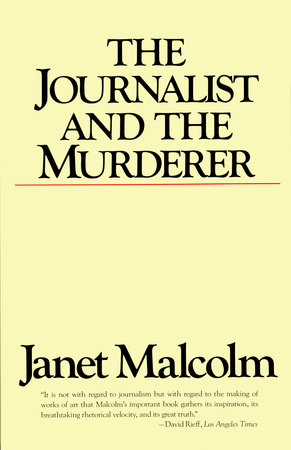
The Journalist and the Murderer by Janet Malcolm (Penguin Random House)
In The Journalist and the Murderer, Janet Malcolm delivers one of the most unsettling and essential examinations of journalism ever written. Using the legal battle between writer Joe McGinniss and murder suspect Jeffrey MacDonald as its core case, Malcolm dismantles the comforting myth of journalistic innocence, arguing that the reporter–subject relationship is inherently unequal and morally fraught. Her famous opening line—“Every journalist who is not too stupid or too full of himself to notice what is going on knows that what he does is morally indefensible”—sets the tone for a book that forces readers to confront the ethics of trust, manipulation, and narrative control. Less a true-crime account than a philosophical inquiry, the book remains a bracing challenge to anyone who believes journalism can ever be entirely neutral, or entirely clean. – PL
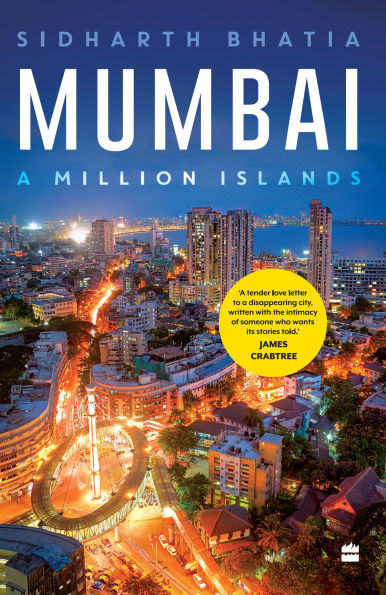
Mumbai: A Million Islands by Sidharth Bhatia (HarperCollins India)
Since our publisher is in India for the month, we thought a related book would be appropriate to highlight this week. Mumbai: A Million Islands by Sidharth Bhatia, co-founder of The Wire, is a richly detailed exploration of how Mumbai evolved from a scattered group of islands into one of the world’s most complex and densely populated cities. The book traces the city’s layered history—from colonial engineering projects that literally stitched the islands together, to the social, economic, and political forces that shaped modern Mumbai. Bhatia blends urban history with sharp cultural observation, showing how land reclamation, migration, capitalism, and resilience defined the city’s character, while also highlighting the tensions between development, inequality, and memory that continue to shape Mumbai today. – PL
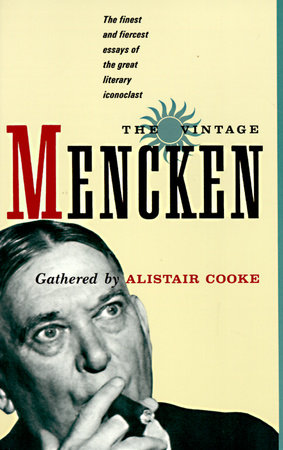
The Vintage Mencken: The Finest and Fiercest Essays of the Great Literary Iconoclast is a bracing reminder of H. L. Mencken’s unmatched ability to puncture pretension and expose the hypocrisies of American public life. Spanning decades of his writing, the collection showcases Mencken at his most incisive—skewering politics, religion, mass culture, and the habits of the American middle class with wit that is at once elegant and merciless. While some of his views are firmly rooted in his era, the essays remain valuable for their clarity of thought and fearless prose, offering a master class in argumentative writing and editorial voice. For readers interested in the tradition of sharp, opinionated journalism, The Vintage Mencken stands as both an artifact of its time and a reminder of how powerful—and unsettling—strong writing can be. – PL
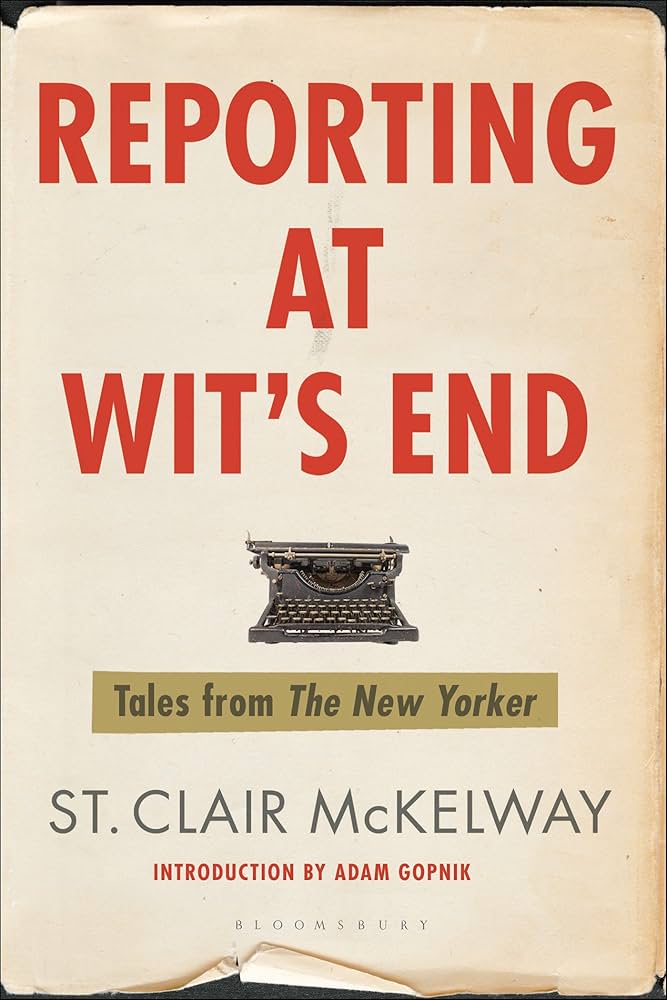
Reporting at Wit’s End: Tales from The New Yorker by St. Clair McKelway (Bloomsbury)
This sharp, often dryly funny reminder of a period when reporting prized patience, close observation, and narrative restraint. McKelway, a longtime New Yorker writer and editor, offers behind-the-scenes accounts of reporting assignments, newsroom culture, and the small human absurdities that accumulate when journalists spend years cultivating sources and chasing elusive truths. The book isn’t a how-to manual so much as a portrait of reporting as a lived practice—slow, meticulous, and frequently humbling. For readers interested in how institutional journalism once worked at its best, Reporting at Wit’s End is less nostalgic than instructive, showing how wit, skepticism, and endurance can coexist with rigor. – PL
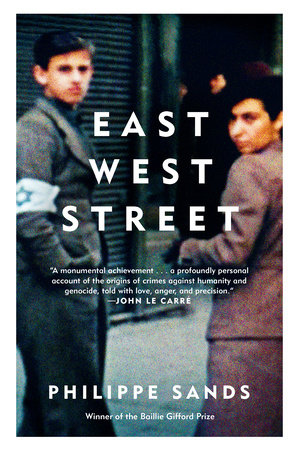
East West Street: On the Origins of "Genocide" and "Crimes Against Humanity (Penguin Random House)
Philippe Sands’s East West Street reads like a legal thriller with a historian’s spine and a memoirist’s nerve: it traces how two foundational ideas of modern international justice—“crimes against humanity” and “genocide”—were shaped by two jurists from the same city (Lviv/Lemberg/Lwów), then follows the trail back through family history, archives, and the wreckage of World War II. Sands toggles between courtroom concepts and lived consequences, showing how abstract language gets forged under pressure—and how it can both reveal and obscure what happened to real people. The book is also propelled by a chilling parallel biography of Hans Frank, the Nazi governor of occupied Poland, which turns the narrative into something sharper than intellectual history: a meditation on accountability, memory, and what it means to name a crime correctly when the stakes are life, death, and legacy. – PL
Dispatches by Michael Herr
Michael Herr’s Dispatches isn’t just a Vietnam War book—it’s the book that taught a lot of modern war reporting how to sound. Written in a wired, breathless, sometimes hallucinatory voice, readers feel the heat and hear the noise of the late-’60s conflict as experienced by grunts, correspondents, and anyone else caught in the churn. Herr isn’t interested in tidy lessons or distant strategy; he’s after the way war rewires language and perception, how rumor hardens into “truth,” and how the spectacle metastasizes until it’s hard to tell where the battlefield ends and the story about it begins. The result is immersive and unsettling—equal parts reportage and reckoning—and it leaves you with the feeling that the war didn’t just happen to Vietnam, but to everyone who tried to witness it. And if it feels like you’ve seen some of the scenes before, you probably have if you’ve watched Apocalypse Now (1979). The movie pulls much of its absurdity from Herr’s classic piece of war reportage. – PL

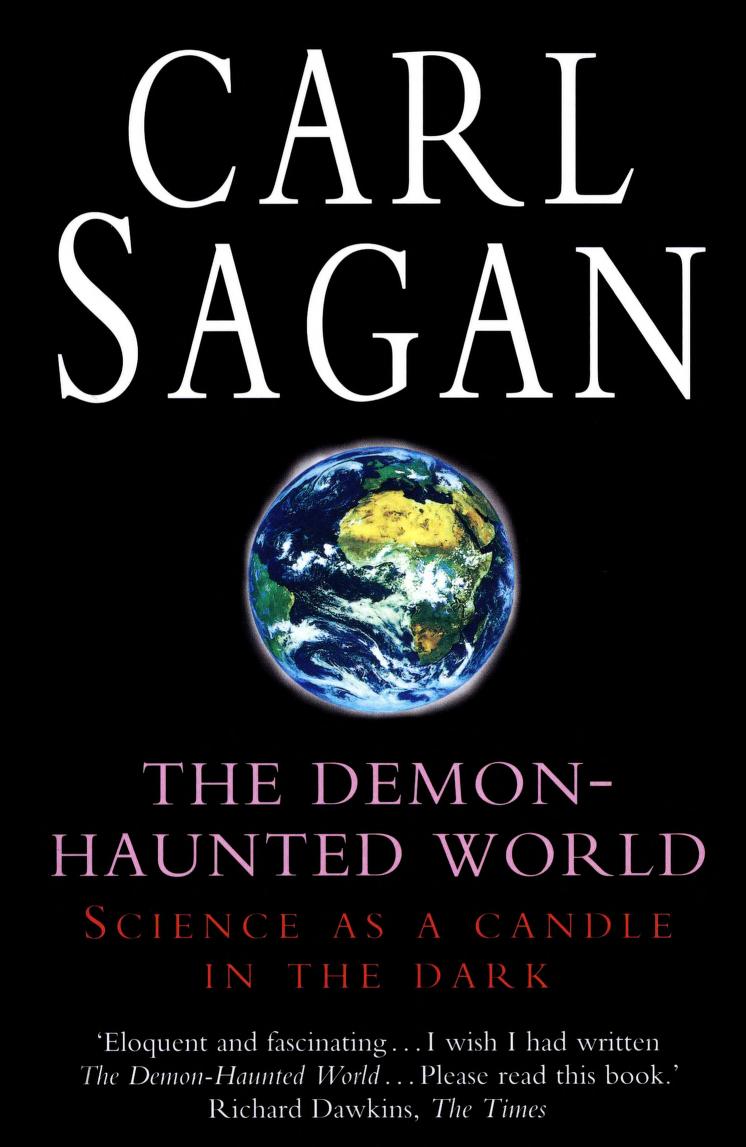
The Demon-Haunted World: Science as a Candle in the Dark by Carl Sagan
"Carl Sagan was a friendly and reliable voice about serious concerns, from public school failure to global warming. His optimistic embrace of the wonders of the natural world was infectious. This non-fiction bestseller from 1996, published just before his death at age 62, speaks to the role science has played in quelling the fears, panic and bad decisions plaguing the inherently superstitious human race over the centuries.Yet, three decades since its release, it is shocking to re-read. Society has not progressed. Society has not progressed as it might have, and the consequences of steady anti-science propaganda and disinformation have undermined our capacity to self-govern." |
-gjw
Murder Your Darlings: And other Gentle Writing Advice from Aristotle to Zinsser by Roy Peter Clark
Clark is the author of some 20 books on writing, and has taught the craft for
40 years. This volume draws upon 50 of the best writing books on his list and
has more than 100 tips on good, effective writing. His counsel is for writers of
any kind: journalists, essayists, novelists: for anyone who writes, at whatever
level. What does “Murder Your Darlings” mean? As advice to writers, who
sometimes believe they’ve composed a wonderful, clever, cute, or funny line,
they should take a close second look, because what they’ve done may not be
all they believe it’s cracked up to be. These are the “darlings,” that authors
may take great pride in, but they might do well to murder (delete) them, or
have their editor advise on how to murder these darlings. Who said “Murder
Your Darlings” first? The NJ staff discussed this: one said Oscar Wilde, another
said William Faulkner. But the prize goes to Sir Arthur Quiller-Couch, British
writer and editor, 1863–1944.
“In the introduction to Chapter 15 of Clark’s book, he admonishes all writers and would-be writers: “Develop the writing habit. Find a reliable work space, free of distractions, where you can aim for a daily level of production.” Sound advice, but most books on writing contain this injunction or one just like it. But he goes on, in ’The Toolbox’ section of this chapter: “Stephen King offers an odd bit of advice: that you should read bad writing so you can learn what not to write.” King is known for his tales of horror, but many writing teachers look to him as a master of the craft, and recommend his book “On Writing: a Memoir of the Craft.” |
-dg

Trust: The Social Virtues and The Creation of Prosperity by Francis Fukuyama
Fukuyama argues that only societies with a high degree of social trust can create the flexible, large-scale business organizations needed to compete in the global economy. His take on American individualism challenges the reality of the U.S. economy and its ability to sustain mega-corporations while maintaining traditional values. He states, "We cannot divorce economic life from cultural life," a concept so deeply entrenched in American mythology that it has become its cultural movement.
“A people’s ability to maintain a shared ‘language of good and evil’ is critical to the creation of trust, social capital, and all the other positive economic consequences that flow from these attributes. Diversity surely can bring real economic benefits, but past a certain point it erects new barriers to communication and cooperation with potentially devastating economic and political consequences.” |
-acs
Evicted: Poverty and Profit in the American City by Matthew Desmond (Crown)
Matthew Desmond’s Evicted is a rare work of journalism that manages to feel both intimate and systemic at the same time. Following eight families in Milwaukee, Desmond documents the day-to-day realities of housing instability with a level of access and detail that reads almost like a novel—but every scene is deeply reported. What emerges is a clear, unsettling argument: eviction isn’t just a symptom of poverty, it’s a driving force behind it. By embedding himself in the lives of both tenants and landlords, Desmond shows how precarious housing shapes everything from employment to education to mental health. What makes Evicted especially powerful is its restraint. Desmond doesn’t lean on overt moralizing; instead, he builds his case through accumulation—missed payments, court dates, forced moves—until the structural failures become impossible to ignore. It’s journalism that trusts the reader, grounded in data but carried by human stories. For anyone interested in inequality, policy, or the lived experience behind economic statistics, Evicted is essential reading. – PL
Tattva Bodha by Sankanacharya
In this book Sankaracharya explores the creation, composition, and characteristics of the mind, intellect, memory, and ego. He discusses the three types of bodies we possess during waking, dreaming, and deep sleep. Ultimately, he reveals that which is uncreated is our true self, a reality transcending all bodies and definitions.
“Just as a bangle, an earring, a house, etc., are thought to be mine, they are distinctly different from me. One can therefore see the error to the conclusions ‘my body’, ‘my physiological functions', 'my mind', 'my intellect', 'my ignorance'; recognizing clearly that 'I' am none of these things.” |
-acb
Whose Freedom? The Battle over America’s Most Important Idea by George Lakoff
Lakoff’s book examines America’s obsession with the concept of freedom and its ongoing struggle to translate that idea into reality. His argument is framed by the aftermath of the September 11, 2001, attacks, when President George W. Bush declared the US could strike political enemies first because “freedom is on the march.”
“Political freedom is about the state and how well a state can maximize freedom for all its citizens. A state can act to guarantee freedoms, to provide more freedom, or to take away freedom. From this perspective, states are to be judged on the basis of how well they guarantee freedoms for all their citizens and provide for as much freedom as possible, while restricting freedom as little as possible.” |
|---|
-acs
Great American Prose Poems from Poe to the Present edited by David Lehman
A prose poem is a poem written in prose rather than verse. A bit of
controversy surrounds the prose poem, as some writers of verse have said,
That’s not poetry, that’s just paragraphs! This troubling debate continues to
the present day.
Lehman, editor of The Best American Poetry series, defines the prose poem in
his 16-page introduction to the anthology, describing the prose plem as a kind
of ‘living contradiction’, or something of an oxymoron—which ‘squares the
circle.’ Is it prose? Is it poetry? The answer to both questions is: Yes. Lehman
describes its French origins and its history in the United States. Many great
masters of American literature are included, as are contemporary writers.
The form has become an attractive option for many poets today. Some
American prose poems are more than a little humorous, and this collection is
sure to entertain and inform anyone interested in the state of the art today. -dg
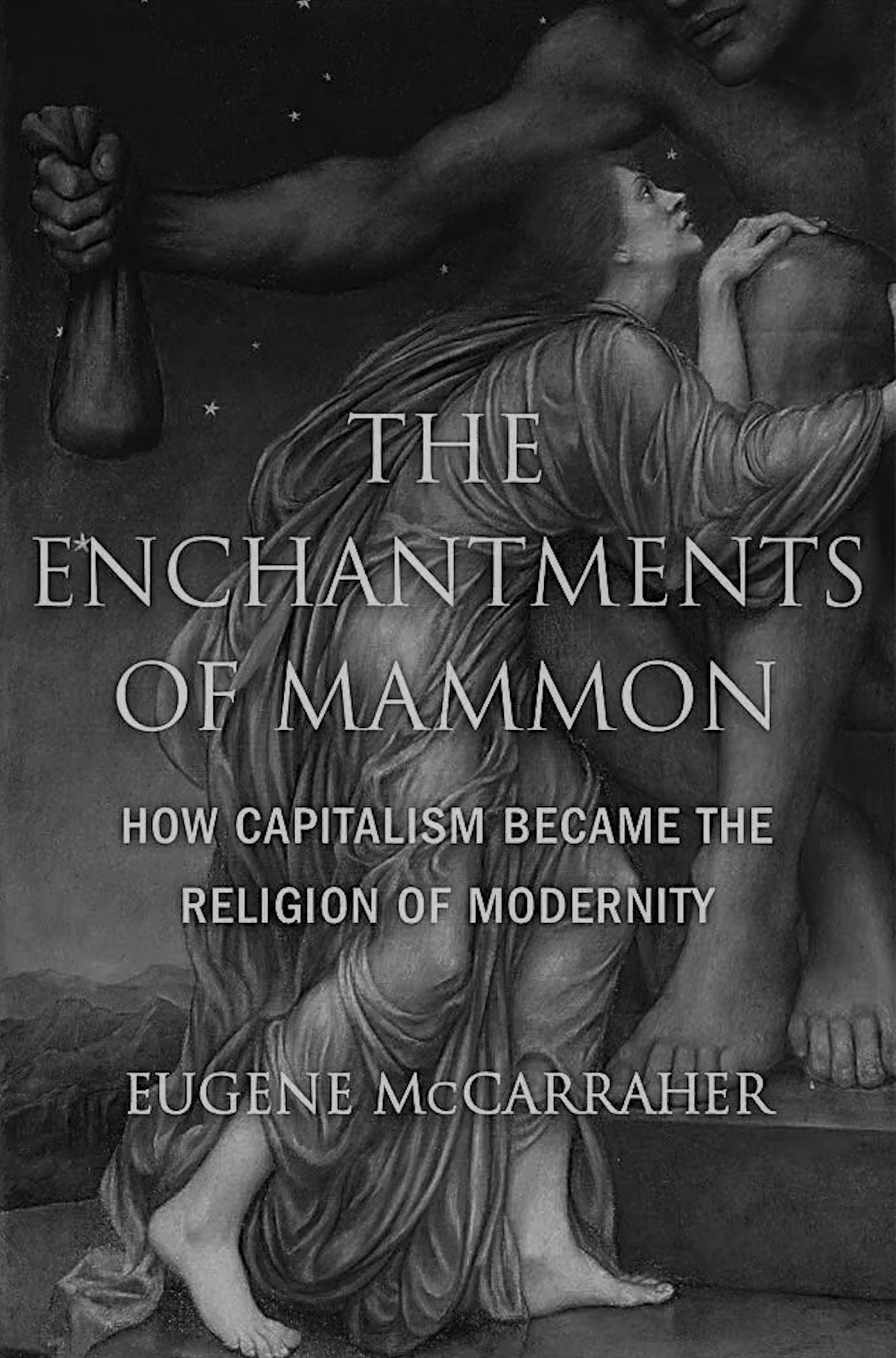
The Enchantments of Mammon: How Capitalism Became the Religion of Modernity by Eugene McCarraher
McCarraher's book explores how capitalism, through its allure of success and purpose, has exploited spiritual yearning, resulting in a warped kind of enchantment centered on material gain instead of genuine liberation.
“We will not be saved by our money, our weapons, or our technological virtuosity; we might be rescued by the joyful and unprofitable pursuits of love, beauty, and contemplation” |
|---|
-sl
Black Pill: How I Witnessed the Darkest Corners of the Internet Come to Life, Poison Society, and Capture American Politics by Elle Reeve
Leaving conjecture behind, Elle Reeve steps into the center of a political storm and puts her journalistic skills into play. Black Pill is the product of months of direct contact with white supremacist groups who accepted her for her honesty and courage. As a reader, we can’t help but benefit from her story. There is no way you won’t finish this book once you start the first chapter—impressive.
“There is no more separation between the online world and the real world,” Fred said. It was getting close to midnight, and sports highlights were replaying on a huge screen behind him. “This notion we have that what is happening online, is happening online—is wrong. Everything happening online is happening in reality. Everything happening online is happening in the real world.” |
|---|
-gjw

The Medium is the Massage: An inventory of effects by Marshall McLuhan
McLuhan’s The Medium is the Message serves as a field guide to understanding the complexities of media, offering a framework rooted in sociology and philosophy. His work has inspired generations of scholars and theorists to look beyond the content itself and explore the methods of communication that shape how messages break through traditional barriers.
“The goose quill put an end to talk. It abolished mystery; it gave architecture and towns; it brought roads and armies, bureaucracy. It was the basic metaphor with which the cycle of civilization began, the step from the dark into the light of the mind. The hand that filled the parchment page built a city.” |
|---|
-acs

Spunk and Bite by Arthur Plotnik
‘Spunk & Bite, A Writer’s Guide to Bold, Contemporary Style,’ a play on
the title of the famous writing guide ‘Strunk and White’, is a set of lessons for
bringing writing to life, and make it engaging, stimulating, and enjoyable to
read. Writers who want to break away from the pack and compose work with
punch, vivacity, wit, and vigor will benefit from this book. Author Arthur
Plotnik helps writers enliven and energize their style, with creative, offbeat,
and at times forceful ways of writing. While there are rules and conventions
that must be obeyed, Plotnick teaches writers how to get around them and to
be both “sheriff and outlaw” in their work.
“What we have here—a gulag for deviant writers? Whenever I review those dictates from ‘The Elements of Style’, that cynosure of American writing by William Strunk Jr. and E.B. White, I feel I should make a dash for it, vault the gates of the free zone.” |
|---|
-dg
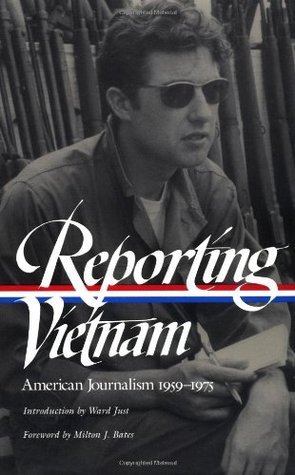
Death in the Ia Drang Valley by Specialist 4/C Jack P. Smith “The 1st Battalion had been fighting continuously for three or four days, and I had never seen such filthy troops. Some of them had blood on their faces from scratches and from other guys’ wounds. Some had long rips in their clothing where shrapnel and bullets had missed them. They all had that look of shock. They said little, just looked around with darting, nervous eyes.” |
|---|
-gjw
This week, we are reading the iconic novel It Can’t Happen Here by Sinclair Lewis. His 1935 piece investigates the rise of fascism in the United States, revealing the complex, but not so far fetched, pathways that facilitate oppressive systems on home soil. We ask our readers: can it happen here?
“More and more, as I think about history,” he pondered, “I am convinced that everything that is worth while in the world has been accomplished by the free, inquiring, critical spirit, and that the preservation of this spirit is more important than any social system whatsoever. But the men of ritual and the men of barbarism are capable of shutting up the men of science and of silencing them forever.” |
|---|
-acs

Mark Twain was the first modern American novelist. Mark Twain was also racist! The first assumption is hard to dispute. No greater arbitrator of literature than Ernest Hemingway famously said, “All modern American literature comes from one book by Mark Twain called Huckleberry Finn.” That book has been a staple of high schools since 1940. But over that last decade or so, it’s been a controversial part of the curriculum.
That’s because of a racial slur that was at the time of Twain’s writing commonplace. Do we really need to say it? Using the word now is like a punch to the face. Students blanch reading it in a text that has been deemed a classic. A classic to whom? Young people of all stripes have placed it in the problematic pile. It’s certainly not a safe space.
There’s no argument that the word is offensive and Twain was using it not to denigrate but capture the vernacular. The whole story can be read as Huck’s evolution from seeing Jim as property to a person. The emotional climax of the novel comes as Huck contemplates returning Jim to his owners as the right thing to do, but having seen Jim crying over his wife and children he no longer believes Jim is an object, a commodity. "All right, then, I'll go to hell," he says, choosing damnation and his friend over what society tells him is right.
No one should deny the feelings of those who find The Adventures of Huckleberry Finn racist. But school isn’t about feelings. It’s about critical thinking, or it should be. Not a popular topic, but one that has repercussions beyond the classroom. If we can’t discuss topics that divide us then we will never be united.